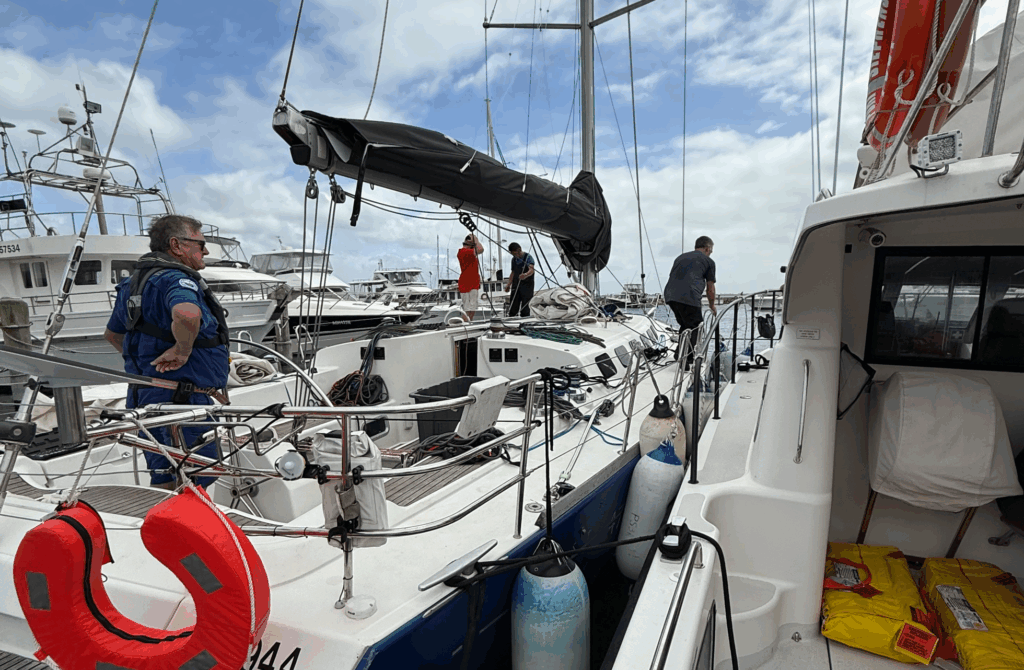
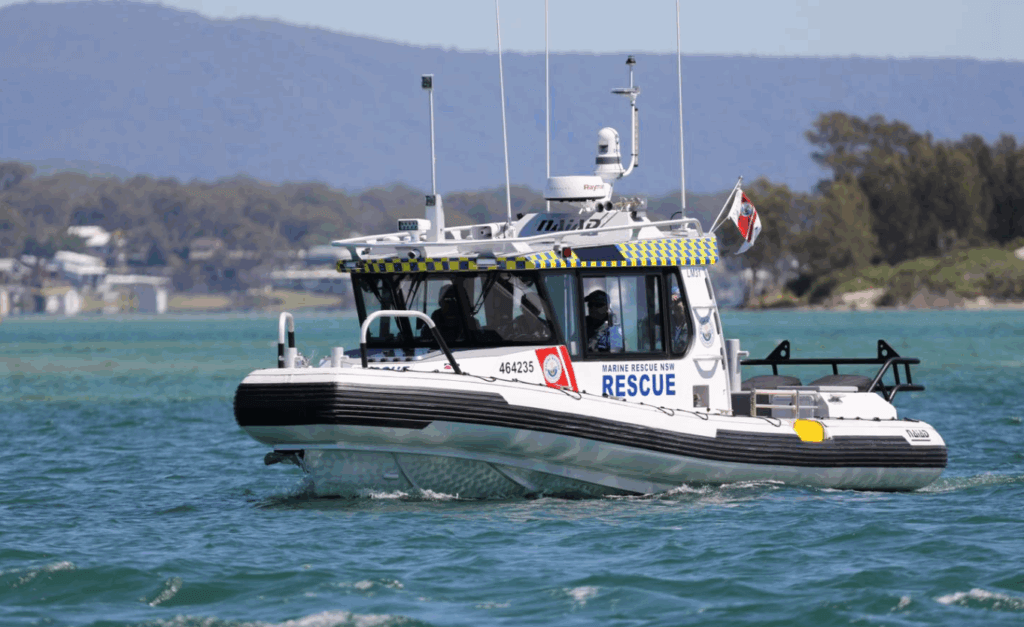
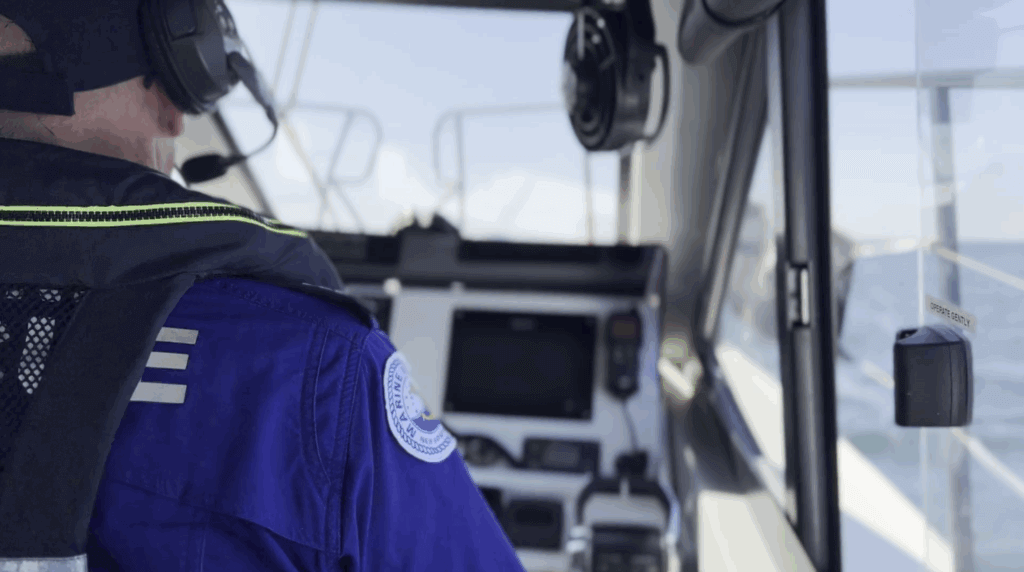
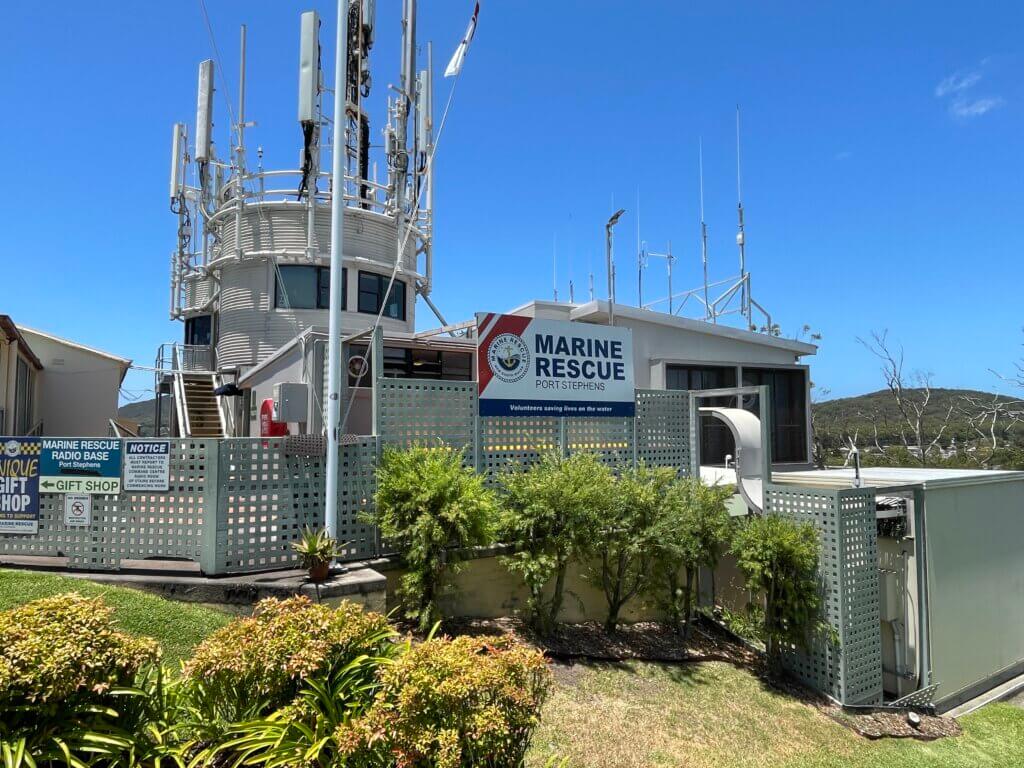
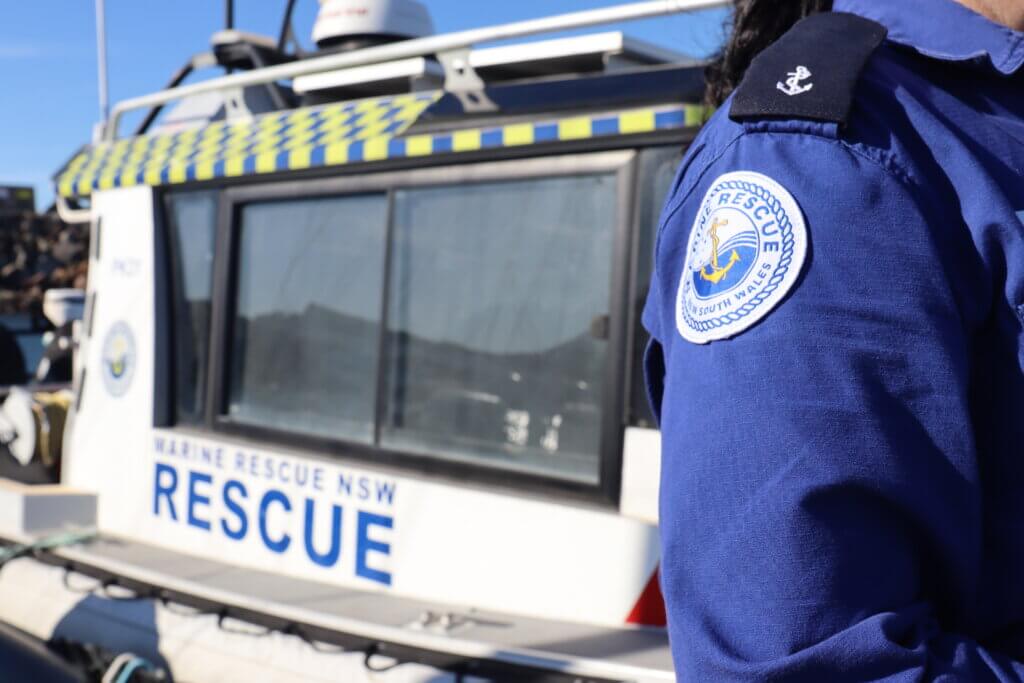
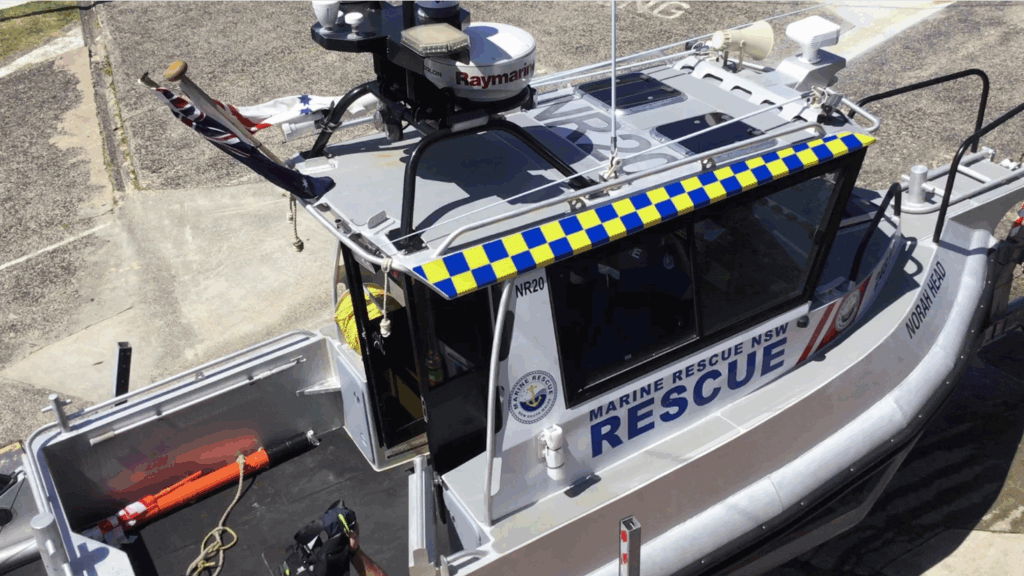
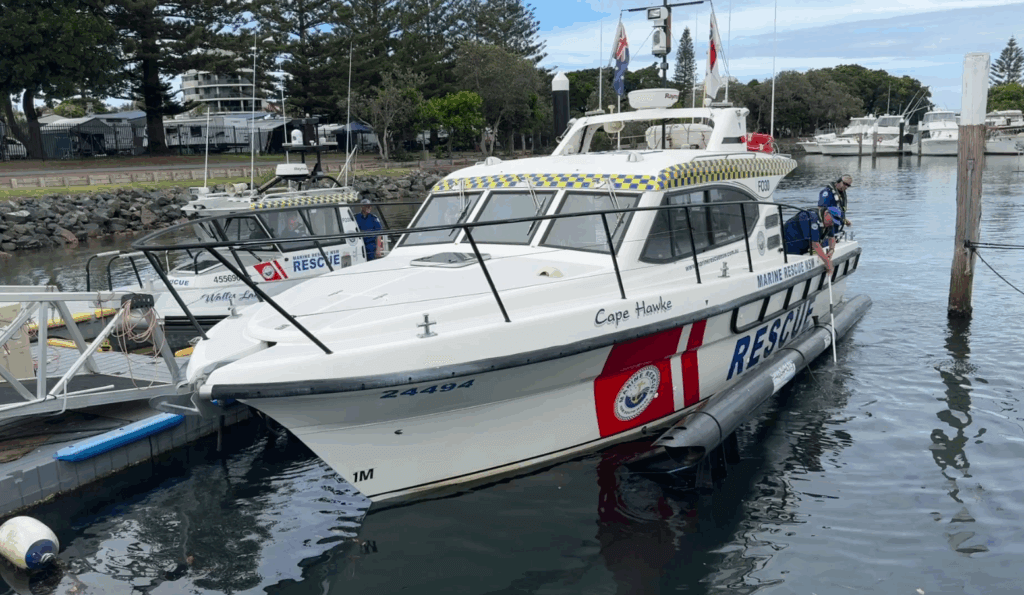
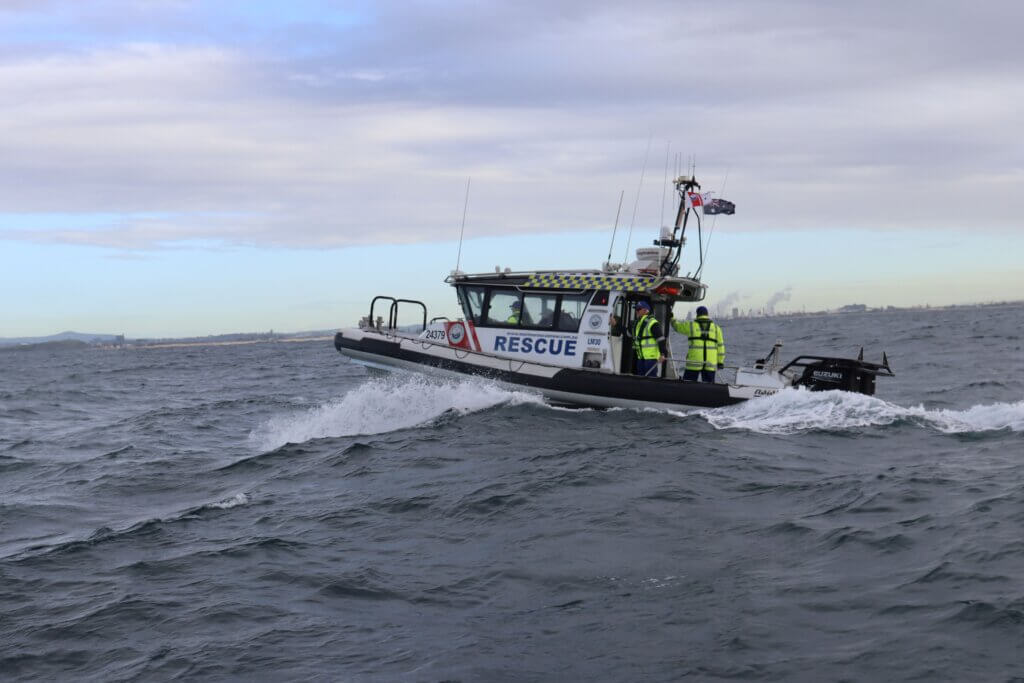
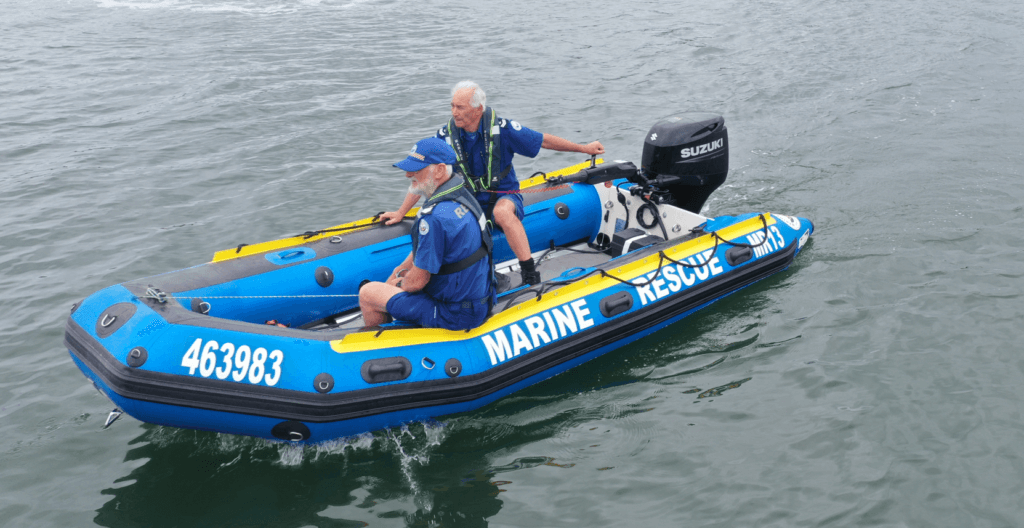
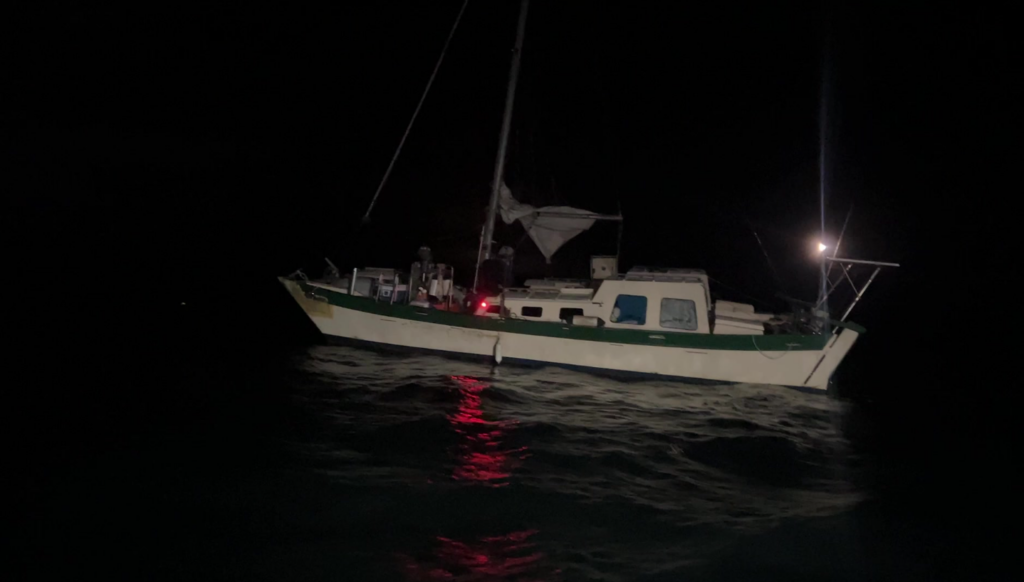
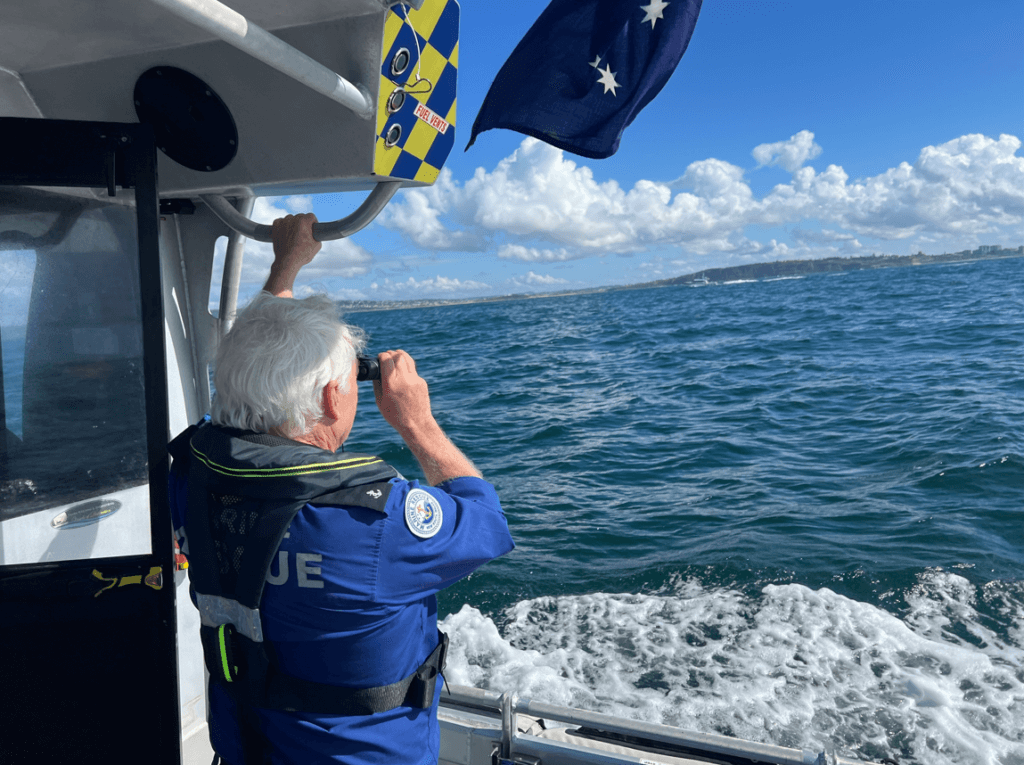
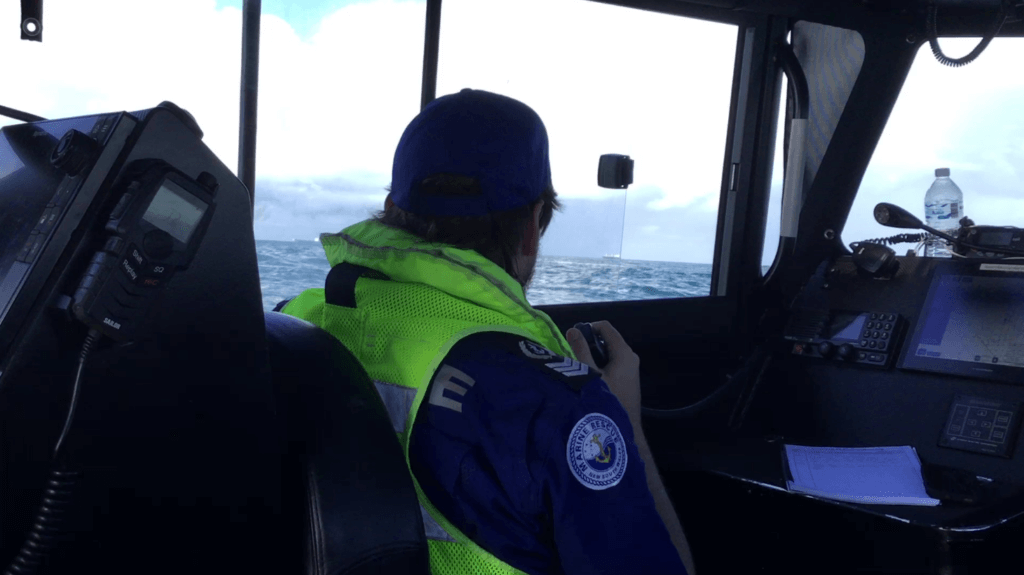
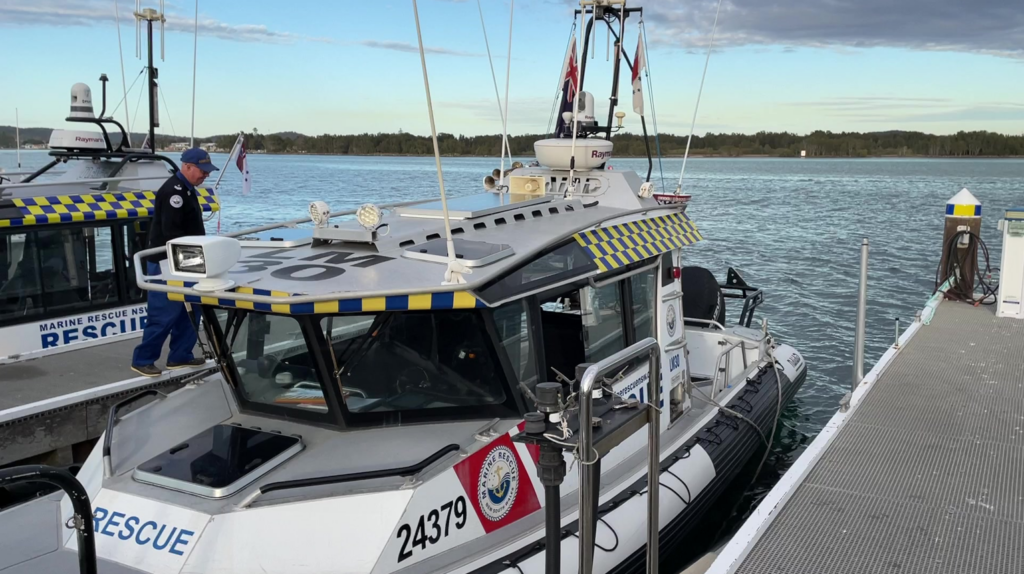
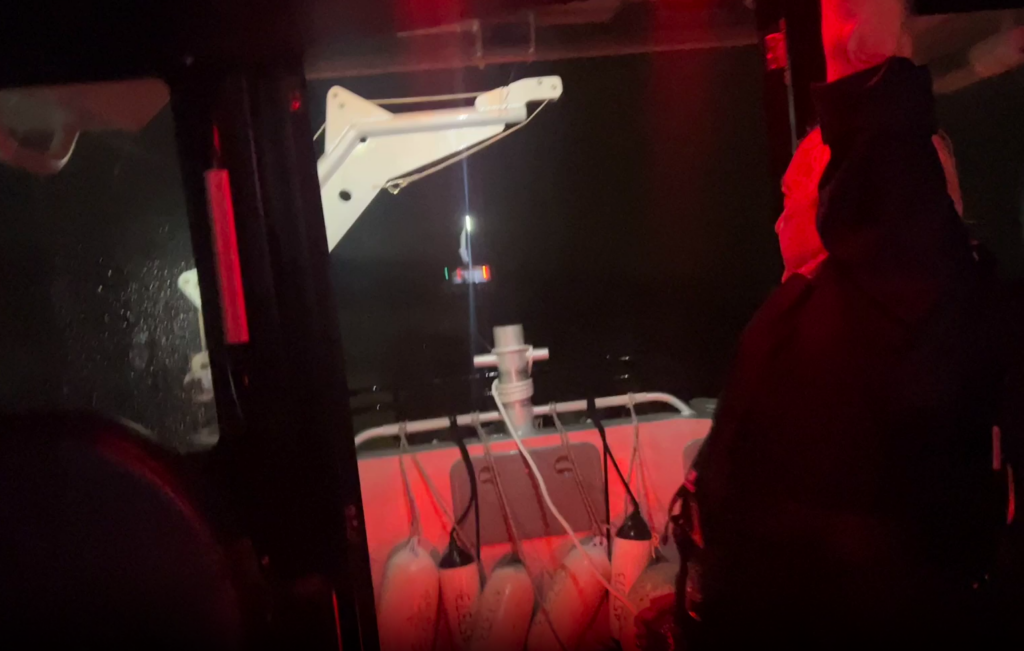
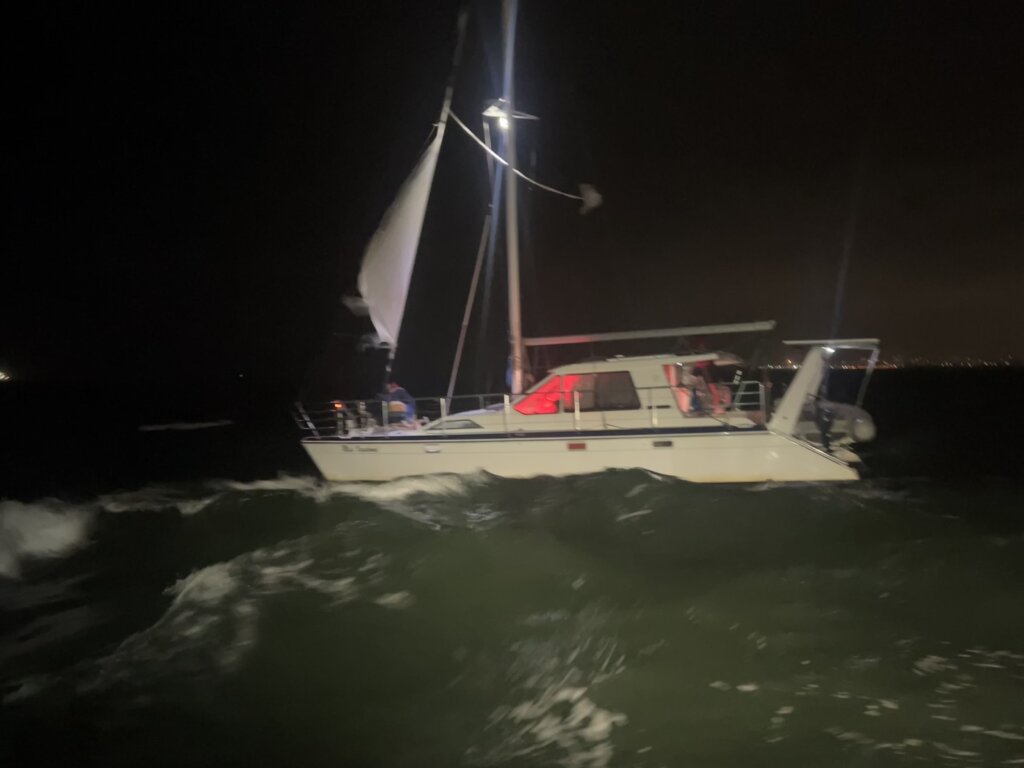
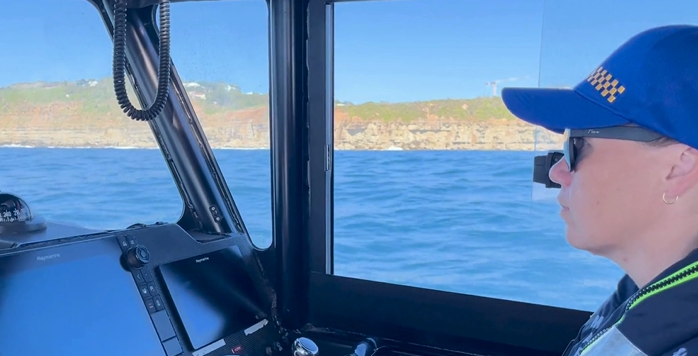
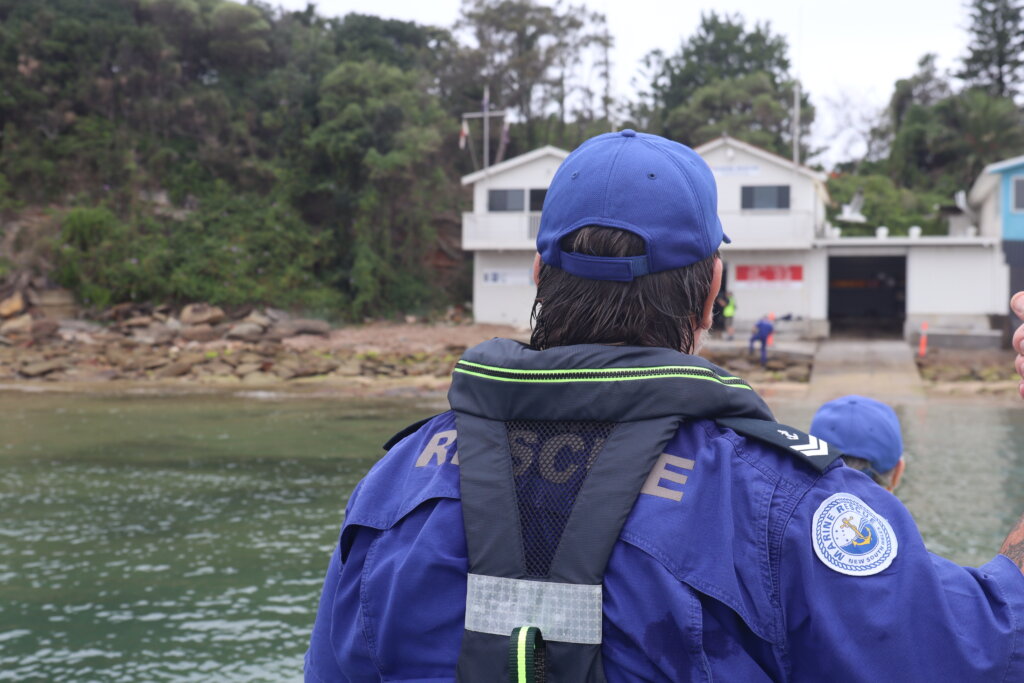
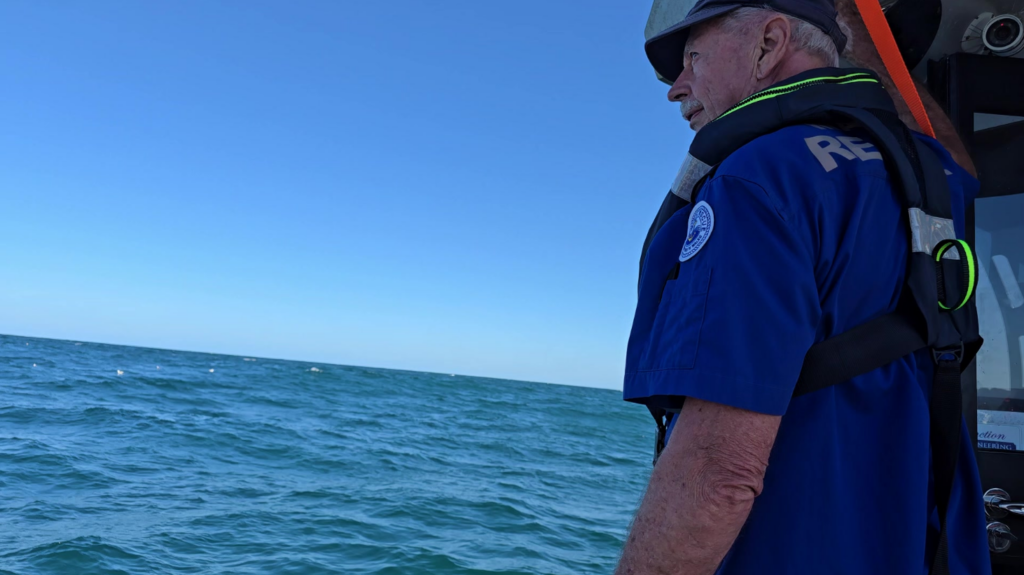
Volunteers from Marine Rescue Port Stephens responded to a late-night call for assistance after a 12–15 metre yacht lost steerage between Seal Rocks and Broughton Island while transiting from Lord Howe Island last night (Sunday 7 December).
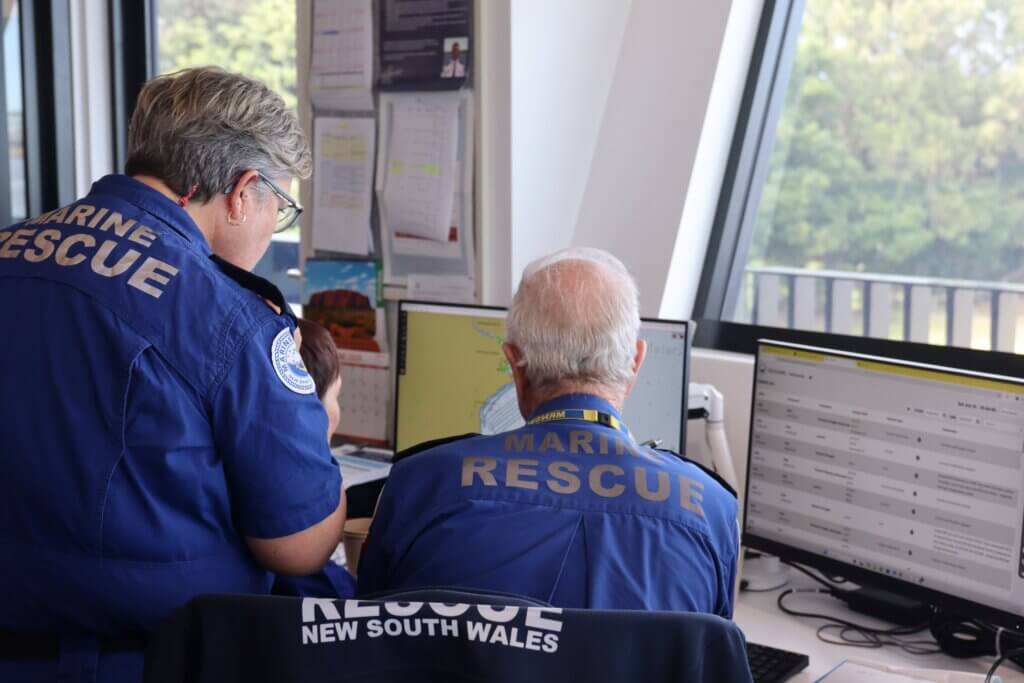
Radio Operators at Marine Rescue Sydney took the initial call from the skipper of the disabled vessel before transferring communications to volunteers at Marine Rescue Port Stephens.
Marine Rescue NSW Inspector Jane Shirriff said Marine Rescue Port Stephens was tasked to assist, with a crew deployed on board Port Stephens 31 just after 11:15pm.
“Unfortunately, the skipper of the yacht suffered an eye injury while attempting to fix the issue, increasing the urgency of the response.
“PS 31 reached the disabled vessel, which was seven nautical miles (13km) north of Broughton Island and six nautical miles (11km) offshore.
“They checked the welfare of the crew on board the yacht before securing a tow line and heading for Port Stephens.
“It was quite uncomfortable offshore, with 15–20 knot south-easterly winds and a 1.5–2 metre swell.
“It was tough going on the way back, with our crew experiencing choppy conditions, but they persevered and guided the disabled yacht safely into d’Albora Marina, Nelson Bay at 6:20am this morning (Monday, 8 December).
“This mission involved three Marine Rescue NSW units. Sydney managed the initial communications, a crew from Marine Rescue Forster Tuncurry was on standby to assist if required, and the Radio Operators and crew at Port Stephens did a wonderful job in extremely fatiguing conditions,” Inspector Shirriff said.
Volunteers from Marine Rescue Lake Macquarie have retrieved a kayak angler stranded in waters off Pulbah Island after his craft overturned and became semi-submerged late yesterday afternoon (Wednesday, 3 December).
Marine Rescue NSW Inspector Jane Shirriff said a crew from Marine Rescue Lake Macquarie was tasked just after 4:30 pm.
“Rescue vessel Lake Macquarie 31 was immediately deployed, with the crew performing a contour search of the Island where the angler was reportedly in the water.
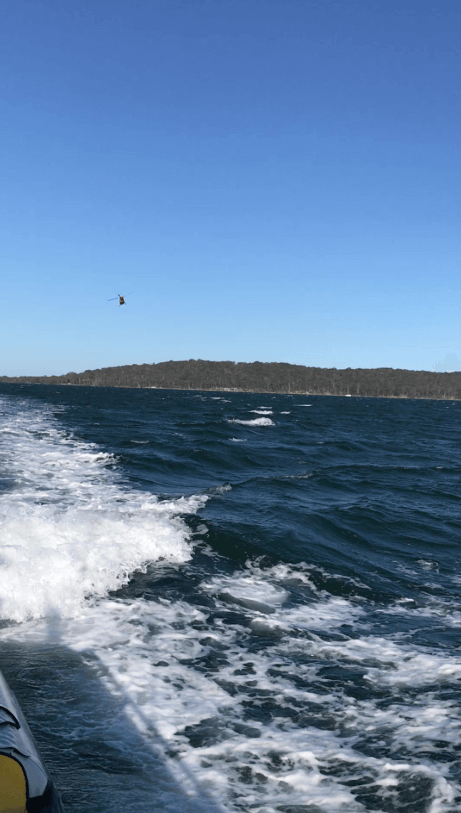
“Aerial assistance also supported the mission, with a rescue helicopter locating the man and directing the Marine Rescue Lake Macquarie crew to his location which was between Pulbah Island and Point Wolstoncroft,” Inspector Shirriff said.
Marine Rescue Lake Macquarie Unit Commander Jim Wright said volunteers on board LM 31 retrieved the man from the water.
“He had been in the water for some time and was quite cold.
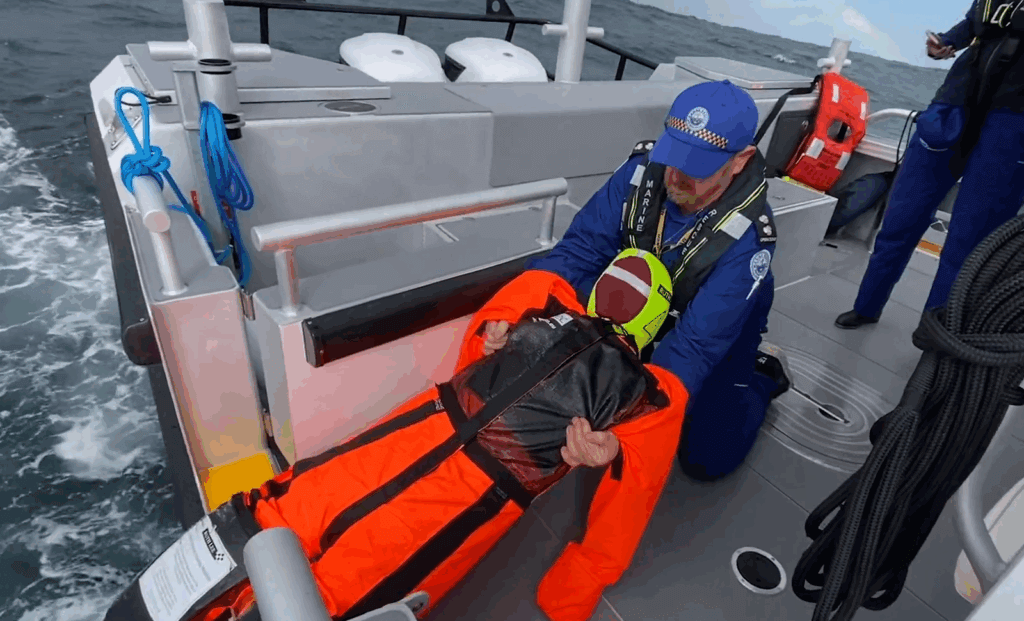
“The Marine Rescue Lake Macquarie crew checked his welfare and wrapped him in blankets to increase his body temperature,” Unit Commander Wright said.
The fisherman said his kayak became unstable and overturned. He was able to get back into the craft the first time, but it rolled a second time and filled with water.
“The man did all the right things. He was wearing a lifejacket — a bright yellow one, which made him easier to see — and he remained with his craft, which is what people in this situation should always do,” Unit Commander Wright said.
“The fact he was wearing a lifejacket and the swift response from both our crew and the rescue helicopter led to a positive outcome. NSW Water Police also assisted on scene; it was an excellent multi-agency response,” he said.
LM 31 returned the man safely to the Marine Rescue Lake Macquarie vessel base at Pelican, while Water Police retrieved his craft.
Unit Commander Wright then drove the man home; he was extremely grateful to have been rescued.
Marine Rescue NSW volunteers and vessels from the Norah Head and Lake Macquarie units are assisting a multi-agency search for a missing male swimmer at Norah Head on the state’s Central Coast.
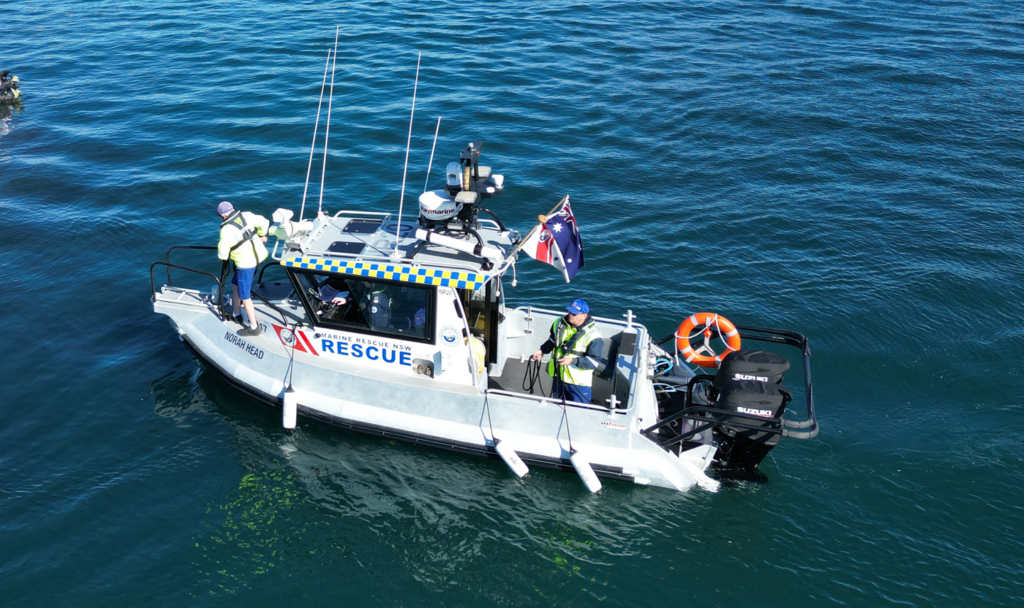
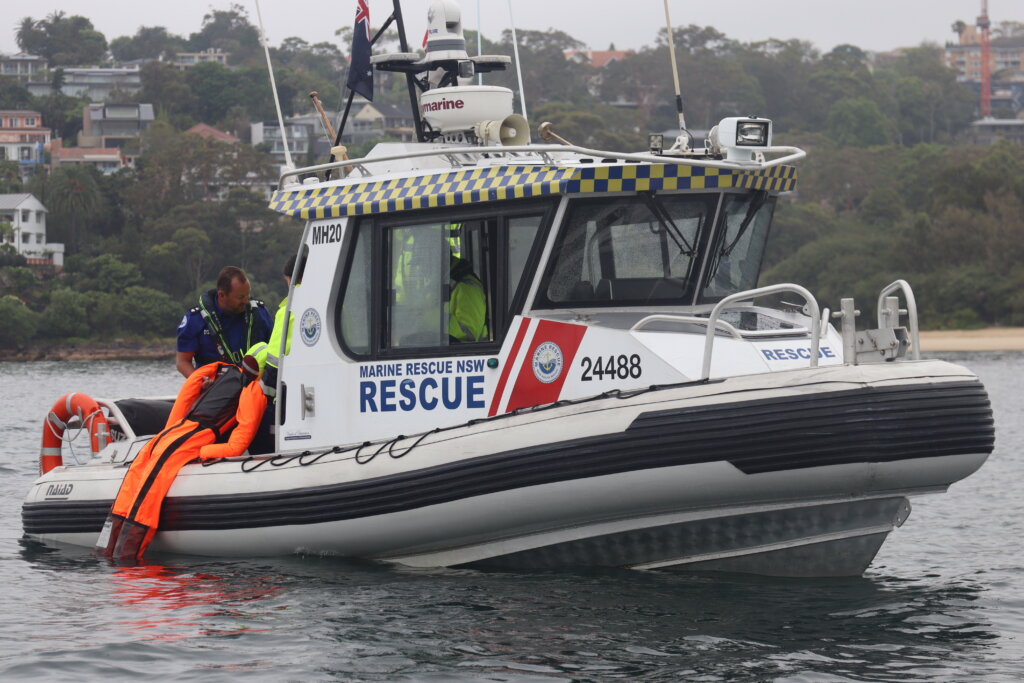
Marine Rescue NSW Inspector Andrew Harding said Norah Head 20 and Lake Macquarie 30 resumed the search at 7am today (Monday 24 November).
“Both Marine Rescue NSW vessels are conducting an expanding parallel-line search, pushing north to Hargraves Beach and south past Pelican Beach.
“Conditions are challenging, with a 2.5 to 3-metre southerly swell and winds up to 15 knots.
“The Marine Rescue NSW crews will continue searching under the direction of NSW Police Marine Area Command until instructed otherwise,” Inspector Harding said.
Volunteers from Marine Rescue Norah Head searched for almost three hours last night after being deployed at 9pm.
“Our crews respond at any time of day or night, and the NR 20 crew answered the call to assist the search last night,” Inspector Harding said.
The skipper of a 12-15 metre monohull sailing yacht called for emergency assistance from Marine Rescue Port Stephens after a fire broke out on board.
Marine Rescue NSW Inspector Andrew Harding said the emergency call was received just after 6am this morning, Sunday 23 November.
“At 6.05am, volunteers at Marine Rescue Port Stephens received a MAYDAY call via a mobile phone from a solo yachtsman, located approximately 2.5 nautical miles (4.6 kms) south-east of Port Stephens Light.
“The experienced skipper advised a fire had started in the vessel’s electrical systems.
“A volunteer crew was rapidly assembled and rescue vessel Port Stephens 31 was en route before 6.30am.
“Fortunately, the skilled skipper of the distressed vessel was able to extinguish the fire and turn the vessel towards shelter,” Inspector Harding said.
While the fire had been extinguished, the electronics on the yacht were melted, making radio communication impossible, and leaving only a compass for navigation. In consultation NSW Police Marine Area Command the call was downgraded from a MAYDAY, the Marine Rescue Port Stephens crew were requested to continue responding to assist the vessel due to its reduced engine and electronic controls.
“The damage caused by the fire made the electronics inoperable.
“The yacht engine also appeared to be stuck in gear, making manoeuvring hazardous.
“At the Nelson Bay breakwall, further attempts to disengage the engine were successful.
“The volunteer crew on board PS 31 rafted the yacht to the rescue vessel and safely escorted the sailor to an emergency mooring.
“The Marine Rescue Port Stephens crew performed exceptionally well in variable conditions and reduced visibility offshore. Passing showers were also a factor during the operation.
“The skipper of the yacht should also be commended; his preparedness prevented the incident from escalating further,” Inspector Harding said.
Matt Coleborne, a volunteer crew member on board PS 31, highlighted the importance of training to ensure crews are rescue ready for any situation that arises.
“We train for multiple scenarios every single week.
“This incident is exactly the kind of situation we simulate.
“On the way to the disabled yacht, one Coxswain focussed on getting us offshore as quickly and safely as possible.
“The second Coxswain stepped through every scenario we might face on arrival, allocating roles and talking through our response options.
“Honestly, the training can feel pretty relentless sometimes in this unit – which is why it can all come together so quickly, even when you’ve just jumped out of bed at 6am on a Sunday morning,” Coleborne said.
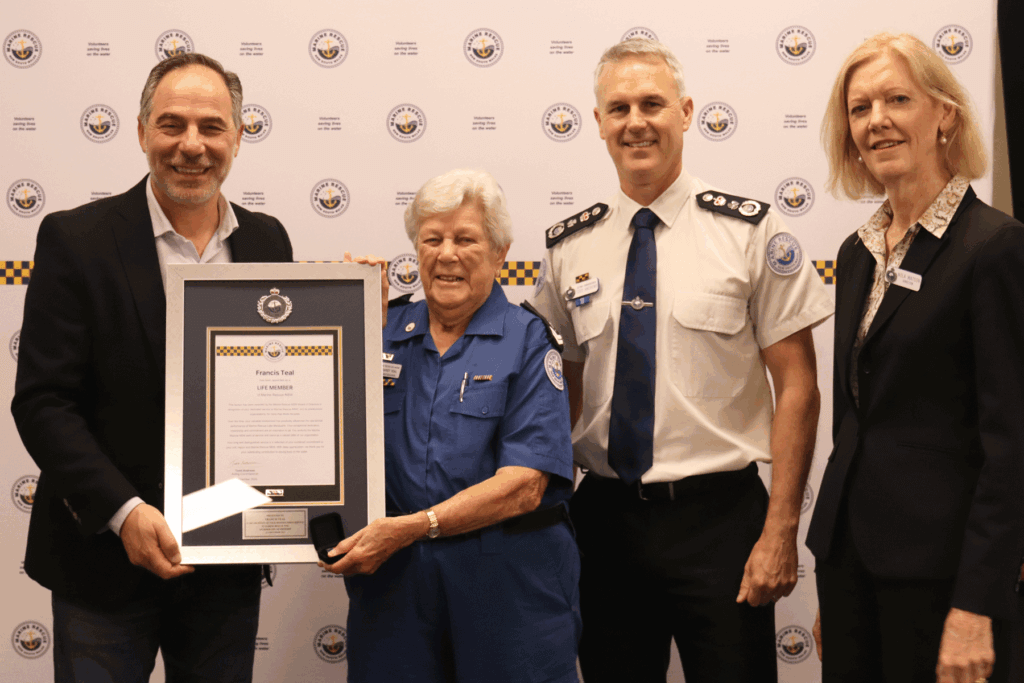
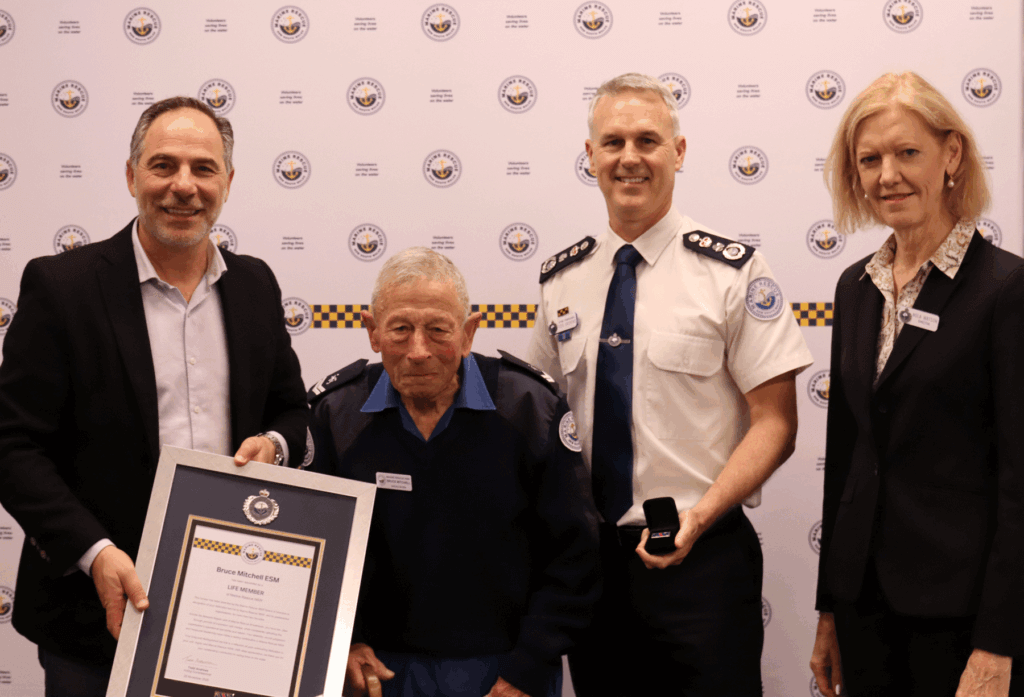
Three outstanding volunteers were today (Saturday 22 November, 2025) awarded Marine Rescue NSW Life Membership at the organisation’s Annual General Meeting in Cronulla, recognising their exceptional commitment, leadership and service. The awarding of Marine Rescue NSW Life Membership is among the highest honours, reserved for individuals whose contribution has shaped both their units and the wider organisation.
Marine Rescue NSW Chair Nola Watson commended the three recipients – Frances (Margaret) Teal of Marine Rescue Lake Macquarie, William (Bill) Blakeman ESM of Marine Rescue Merimbula, and Marine Rescue Shoalhaven’s Bruce Mitchell ESM – describing them as “the very best of what the organisation stands for.”
“Margaret, Bill and Bruce have each given significant service marked by professionalism, compassion and a commitment to the safety of others,” Watson said. “Their leadership has strengthened our units, uplifted our volunteers and enhanced the confidence of boating communities across the state.”
For Frances (Margaret) Teal, today’s Life Membership marks the culmination of an extraordinary 35 years of volunteer service. At 95, she is one of Marine Rescue NSW’s longest-serving female volunteers. Beginning with the Royal Volunteer Coastal Patrol in 1991, Margaret brought an unwavering passion for training and education, particularly in First Aid, where she trained and assessed generations of volunteers.
Her leadership as Divisional Commander during the transition to Marine Rescue NSW, and later as the first Unit Commander of Marine Rescue Lake Macquarie, helped lay the foundations for one of the state’s busiest units. She continues to serve operationally as a Watch Officer at the unit and remains a mentor to new members entering the radio stream.
“Margaret’s commitment over more than three decades has had a profound influence on her unit and on Marine Rescue NSW more broadly,” Watson said. “Her example reminds us of the power of quiet, steady leadership and the impact of helping others build their skills and confidence.”
Bill Blakeman’s 17 years with Marine Rescue NSW follow a lifelong maritime career spanning the British Merchant Navy, Australian Volunteer Coast Guard and senior roles with NSW maritime authorities. Since joining the Royal Volunteer Coastal Patrol in 2007 and transitioning into Marine Rescue NSW two years later, he has played a central role in shaping the Merimbula unit’s capability, culture and operational readiness.
As Unit Commander and long-serving Training Officer, Bill has guided countless volunteers through their qualifications, instilling high standards and ensuring safe, cohesive rescue operations. His efforts to secure a second rescue vessel for enclosed waters, upgrade critical infrastructure and maintain strong financial foundations have transformed the unit into one of the most capable and community-engaged in the region.
Blakeman was awarded the Emergency Services Medal in 2022 and received the NSW Maritime Medal the following year.
Chair Watson commended the personal impact of Blakeman’s leadership. “Bill’s dedication has inspired generations of volunteers. His calm teaching style, his depth of knowledge and his absolute commitment to safety have contributed directly to lives saved on the water.”
Bruce Mitchell’s 25 years of continuous service have been defined by reliability, measured leadership and steadfast support for volunteers across the Illawarra. Joining the Australian Volunteer Coast Guard in 2001 after retiring from business, Bruce quickly emerged as a trusted leader, guiding the organisation locally through the transition to Marine Rescue NSW.
From 2009 to 2022, Bruce managed operations across the Illawarra region, providing regional oversight, interagency coordination and volunteer support. Bruce’s calm management during complex search and rescue missions and his consistent presence for volunteers earned him wide respect across partner agencies and government.
Following his retirement from staff service, Bruce returned as a volunteer, serving as Unit Commander at Shoalhaven and continuing as a mentor and Watch Officer.
Mitchell was awarded the NSW Maritime Medal in 2009 and was recognised on the 2010 Queen’s Birthday Honours list with the Emergency Services Medal.
Watson said his contribution reflected “a rare degree of consistency and integrity.” “Bruce has been a point of stability for volunteers and an asset to every unit and agency he has worked alongside. His service has strengthened the capability, reliability and public confidence of Marine Rescue NSW,” she said.
Across their varied journeys, Margaret, Bill and Bruce share a deep commitment to their communities and to the volunteers they have trained, mentored and supported. Their years of service have saved lives, strengthened units and contributed to the growth and professionalism of Marine Rescue NSW.
“These three Life Members are deeply valued,” Watson said. “Their influence will continue well beyond their years of active service, through the volunteers they have inspired and the safer waterways they have helped create. Marine Rescue NSW is stronger because of them.”
A volunteer crew from Marine Rescue Tuggerah Lakes has safely returned a couple to shore after their vintage four-metre vessel began taking on water earlier this afternoon.
Marine Rescue NSW Inspector Jane Shirriff said NSW Police Marine Area Command requested volunteers from Marine Rescue Tuggerah Lakes to assist the boaters, who were stranded in the middle of Budgewoi Lake.
“A volunteer crew was quickly assembled and rescue vessel Tuggerah Lakes 21 deployed just after 1pm.
“The Westpac Rescue Helicopter was in the area and provided situational awareness from above while Tuggerah Lakes 21 was en route to the distressed vessel,” Inspector Shirriff said.
Marine Rescue Tuggerah Lakes Unit Commander Tony Younglove skippered the rescue vessel and said they checked the welfare of the man and woman on board before securing a towline and returning them and their boat to shore.
“It appears the vessel had a loose propeller shaft, which led to water entering the hull.
“Despite battling wind chop during the second half of the mission, we safely returned the boaters to Toukley Boat Ramp, where they were assessed by NSW Ambulance paramedics,” he said.
Two Marine Rescue NSW vessels with volunteer crews resumed the multi-agency search this morning (Thursday 4 September) for a diver last seen at Skeleton Rocks yesterday.
Marine Rescue NSW Inspector Courtney Greenslade said crews from Marine Rescue Forster Tuncurry and Port Stephens are assisting the search at the request of NSW Police Marine Area Command for a second consecutive day.
“Forster 30 and Port Stephens 31 are conducting a parallel line search in a designated offshore area between Mungo Brush and Yacaaba Head,” Inspector Greenslade said.
“Forster 30 departed base at 6:45am today and joined Port Stephens 31 in the search area before 8am.
“Offshore conditions are favourable with good visibility.
“Our crews will continue working alongside Water Police vessels until instructed otherwise by Marine Area Command,” she said.
Volunteers and vessels from Marine Rescue Port Stephens and Marine Rescue Forster Tuncurry have been deployed to assist in a search for a missing diver near Skeleton Rocks.
Marine Rescue NSW Inspector Glenn Sullivan said radio operators at Marine Rescue Port Stephens received a call from a vessel just after 10:30am on Wednesday, 3 September, reporting that a diver had become separated from their buddy.
“NSW Police Marine Area Command was immediately informed and vessels were tasked from the Marine Rescue Port Stephens and Forster Tuncurry units.
“Volunteer crews were quickly assembled and deployed on board Port Stephens 31 and Forster 30.
“Both vessels will search the area alongside Water Police boats.
“The Marine Rescue NSW vessels will continue searching until instructed otherwise by Marine Area Command.
“Conditions are favourable offshore with a one-metre swell, light winds and good visibility,” Inspector Sullivan said.
After 19 years of unwavering overnight duty, Marine Rescue Port Stephens is farewelling long-serving volunteer Peter Bliss — the quiet force behind more than 8,600 hours on watch and 1,323 shifts, most of them completed when the rest of the country was asleep.
A dedicated night operator, Bliss carved out a unique and essential role at the unit — often logging eight to ten full night shifts each month. Whether it was a routine passage or a midnight MAYDAY, his experienced voice in the radio room provided reassurance to volunteer crews and boaters.
When Bliss moved to Port Stephens in 2005 he thought he would be filling a different role with Marine Rescue NSW.
“I was a Coxswain and wanted to go on the boats, but with work and family, one thing lead to another and I ended up in the radio room and loved it,” he said.
His service was recently recognised with a Unit Commander’s Citation, presented in honour of his extraordinary contribution to safety on the water over nearly two decades.
“Peter’s dedication is the kind that doesn’t seek recognition, but deserves it more than most,” said Unit Commander Ben van der Wijngaart.
“He has been the quiet professional on the night shift — consistent, and utterly dependable.
“His contribution to our operations and culture is deeply appreciated, and we thank him sincerely for his outstanding service,” he said.
Bliss is now stepping back following a recent injury and preparing for a move to Maitland to be closer to family.
“While we hope he enjoys some well-earned rest, we’ll certainly notice the absence of his name on the shift calendar — and the steady voice on the airwaves after dark,” Unit Commander van der Wijngaart said.
Bliss summed up the unique perks of the night shift at Marine Rescue Port Stephens with his usual wit.
“The radio room at 2am can be a serious place — but at least no one’s around to judge how many biscuits you’ve eaten,” he joked.
“It’s been a great experience, this unit is one big family, and I’ll miss them,” he said.
Bliss has left the door open to resume volunteering with unit in the future.
“They are such a great group of people at Marine Rescue Port Stephens, I may return in some capacity but first let’s get the move done and settle into our new life,” he said.
Unit Commander van der Wijngaart said he would welcome him back with open arms and his legacy remains strong.
“Inspired by Peter’s example, several newer members have recently volunteered to take on night shifts — a testament to the culture of quiet professionalism he helped foster,” he said.
The Marine Rescue Port Stephens radio base at Nelson Head operates 24/7 responding to boaters requiring assistance.
The unit is recruiting radio operators to be the voice of safety on the region’s waters.
“People need no prior experience to volunteer with Marine Rescue Port Stephens. We provide full free training and teach new members everything they need to know to help save lives on the water.
“The unit is hosting a volunteer information evening on Monday 25th August, interested persons will find more details on the Marine Rescue Port Stephens Facebook page,” Unit Commander van der Wijngaart said.
Lake Macquarie volunteers at the State’s busiest Marine Rescue NSW unit have already safely returned 672 people to shore and completed 297 search and rescue missions in a busy first half of the year.
The number of people returned safely is consistent with the 681 rescued during the same period last year, as the unit prepares for another busy boating season ahead.
Capability at Marine Rescue Lake Macquarie has been boosted with an enhanced rescue vessel, Lake Macquarie 31, which was officially welcomed today during a commissioning ceremony at the Marine Rescue Lake Macquarie base at Pelican.
Emergency Services Minister Jihad Dib joined Marine Rescue NSW Commissioner Alex Barrell and Marine Rescue Lake Macquarie Unit Commander Jim Wright to commission the vessel.
“Boaters across the state can rest assured that the NSW Government’s investment in Marine Rescue NSW is delivering rapid response rescue vessels with impressive offshore search and rescue capabilities,” Minister Dib said.
“This vessel is built in NSW and has already made a significant contribution to the hundreds of lives saved across the region in support of volunteer efforts.”
“The Government is committed to providing the 184 skilled and dedicated volunteers at Marine Rescue Lake Macquarie with state-of-the-art resources to support their mission of saving lives on the water.”
“This rescue vessel is a valuable investment in the safety of Lake Macquarie, the Hunter Coast’s active boating community and its many visitors.”
Minister Dib also encouraged all boaters to Log On and Log Off with Marine Rescue NSW, either via the free Marine Rescue app or VHF Channel 16.
“Using the Marine Rescue app or contacting Marine Rescue NSW through VHF channel 16 ensures that a search will be initiated for boaters who do not return from a trip as planned,” he said.
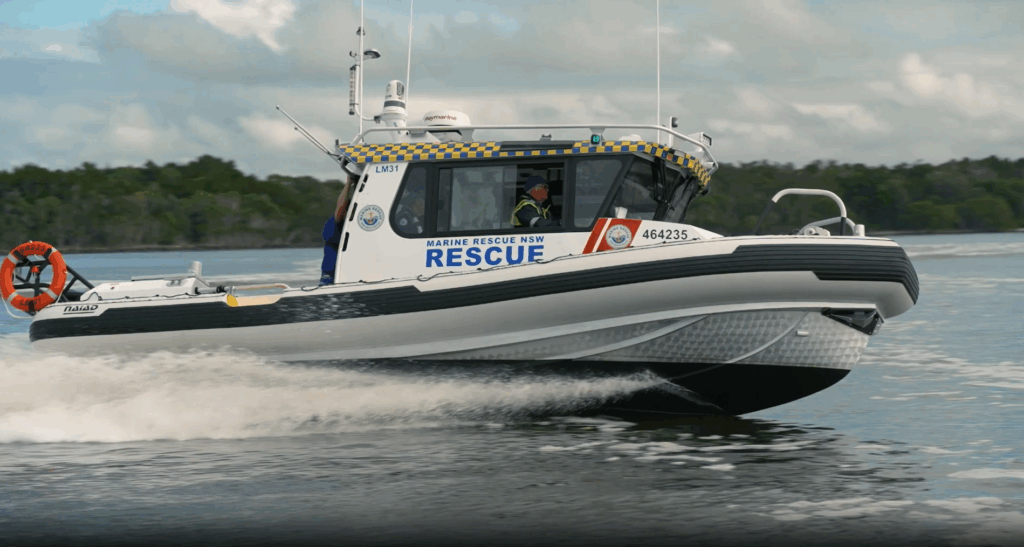
Lake Macquarie 31 is an 8.5-metre Naiad, built by Yamba Welding and Engineering, and replaces the unit’s former 7.5-metre Sailfish catamaran.
Marine Rescue NSW Commissioner Alex Barrell said the vessel is a critically important asset for the popular boating area and thanked the NSW Government for its ongoing financial support.
“LM 31 has enhanced the search and rescue response at Marine Rescue Lake Macquarie. The unit’s fleet now comprises two Naiad rapid response vessels and two rescue watercraft (jet skis),” Commissioner Barrell said.
“This new vessel features an axe-head bow capable of handling heavy bar crossings, a full Raymarine suite of navigation equipment, FLIR (forward-looking infrared camera), radar and sonar.”
“These advanced systems assist our volunteers in operating effectively in all conditions,” he said.
Lake Macquarie 31 is powered by twin Suzuki 250-horsepower outboard engines, capable of reaching speeds of up to 42 knots, and provides lifesaving capability both offshore and on enclosed waters.
“This vessel can rapidly deploy up to 30 nautical miles offshore and has excellent manoeuvrability on the lake,” Commissioner Barrell added.
Unit Commander Jim Wright said volunteers at Marine Rescue Lake Macquarie continue to respond around the clock to emergencies in the area, with crews completing a large number of search and rescue missions this year.
“This unit is busy both on and off the water, with our team of radio operators supporting vessel crews by managing communications and monitoring marine radio 24/7,” he said.
Unit Commander Wright thanked the local community and businesses for their generous support of the unit’s fundraising efforts, which contributed 20 per cent of the cost of the new vessel.
“The unit also extends its gratitude to Daracon Group, McDonald Jones, and Trinity Point Marina for their financial contributions towards Lake Macquarie 31. Their ongoing support is greatly appreciated.”
Marine Rescue NSW is a volunteer based not-for-profit professional organisation dedicated to keeping boaters safe on the water and supporting local communities.
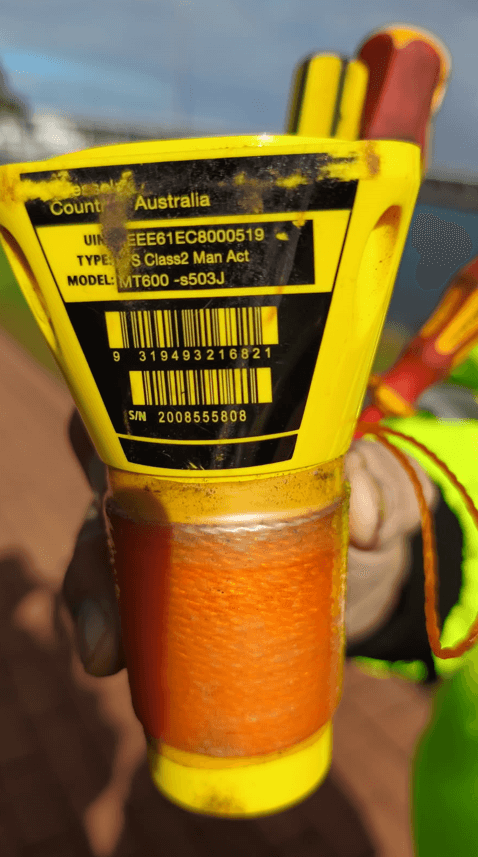
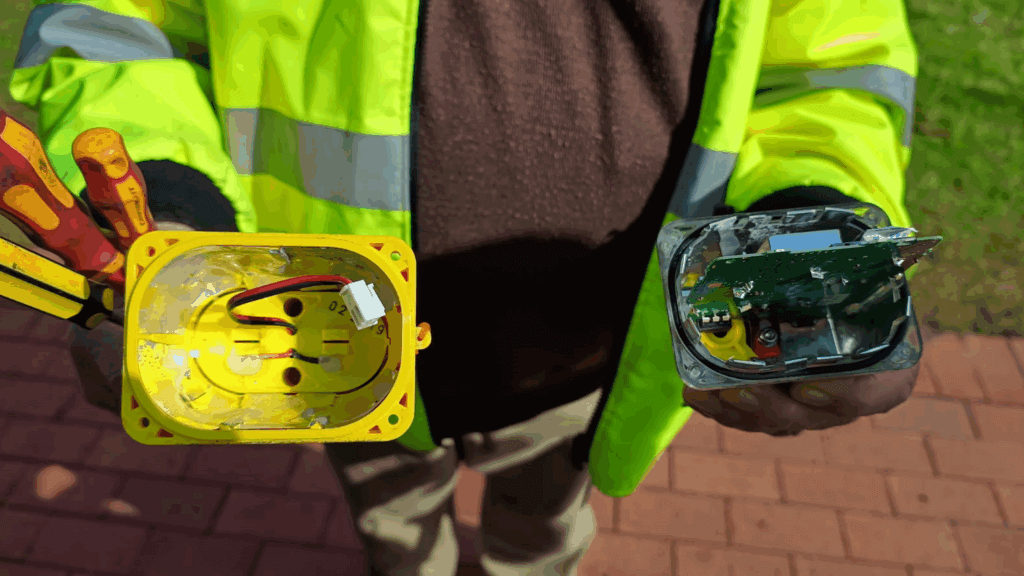
Marine Rescue NSW units on the Hunter and Mid North Coasts responded to an EPIRB activation overnight and this morning, which resulted in the beacon being located and confirmation that no one was in danger.
Marine Rescue NSW Inspector John Murray said he was notified just before 8pm last night (18 July) that a beacon signal had been received by the Australian Maritime Safety Authority’s (AMSA) Joint Rescue Coordination Centre (JRCC) in Canberra.
“Marine Rescue Norah Head was tasked to search for the EPIRB. A volunteer crew was quickly assembled, and rescue vessel Norah Head 20 was deployed.”
“The crew searched waters up to five nautical miles off Norah Head but were stood down after two hours due to deteriorating sea conditions,” Inspector Murray said.
“There was a two-and-a-half-metre swell and strong winds offshore.
“Marine Rescue Terrigal was placed on standby to assist the AMSA jet, which also searched offshore,” he said.
At 10am this morning (19 July), the JRCC received another location signal from the EPIRB, indicating it may be in Forster.
“Volunteers from Marine Rescue Forster Tuncurry responded,” Inspector Murray said.
“Without launching rescue vessel Forster 30, the crew used the onboard radio direction finder and identified a bearing to the possible location of the EPIRB.
“The identified location was not in the water—it was actually at a nearby caravan park.”
“Marine Rescue Forster Tuncurry volunteers immediately went to the caravan park and located the EPIRB in a toolbox inside a small runabout.
“It was deactivated, and it was confirmed that no persons were missing,” Inspector Murray said.
Inspector Murray said a lot of time and resources could have been saved if the EPIRB had been registered.
“It is vitally important that all EPIRBs are registered with the Australian Maritime Safety Authority.
“Registering an EPIRB allows authorities to quickly identify the owner and their vessel in an emergency, significantly reducing response times,” he said.
Two Marine Rescue Port Stephens volunteers, with a combined 30 years of experience between them, have been celebrated during a ceremony at Nelson Head.
Rescue vessel skipper and Watch Officer Laurie Nolan, and IT Systems Lead and Watch Officer Lee Ryman, were presented with the National Medal for 15 years of service by the Member for Port Stephens, Kate Washington MP.
Image: (L to R) Ben van der Wijngaart, Dan Duemmer, Darren Schott, Lee Ryman, Kate Washington MP, Laurie Nolan, Alex Barrell and Todd Andrews
Marine Rescue NSW Commissioner Alex Barrell, Deputy Commissioners Darren Schott and Todd Andrews, Central Zone Commander Dan Duemmer, and Marine Rescue Port Stephens Unit Commander Ben van der Wijngaart also attended the ceremony to acknowledge the pair.
The National Medal recognises long and diligent service by members of recognised government and voluntary organisations who risk their lives or safety to protect or assist the community in times of emergency or natural disaster.
“It is wonderful to see two of our members, Laurie and Lee, being awarded the National Medal for 15 years of dedicated service to Marine Rescue New South Wales. The work and commitment that they’ve given to Marine Rescue Port Stephens over the last 15 years has been a tremendous service not only to our unit but also to the local community,” said Marine Rescue NSW Commissioner Alex Barrell.
Nolan has served in numerous executive and operational roles at the unit, helping to shape policy, training, and operational standards. As a Coxswain and Watch Officer, he has played a direct role in saving lives at sea and mentoring crew members.
“When I first joined Marine Rescue NSW, I never imagined I’d still be doing this 15 years later. Back then, I was the one soaking up every bit of experience I could from the old hands. These days, I find myself in their shoes—mentoring the next generation, passing on what I’ve learnt about seamanship, staying calm under pressure, and just showing up for each other.
“Every call-out teaches you something. It’s not about medals—it’s about being there when someone needs help, no matter the time or weather. That’s what we do. And if I can help a new crew member find their confidence, then that’s worth more than any award.
“Volunteering with Marine Rescue Port Stephens is a fulfilling experience. Over 15 years, I’ve seen first-hand how a calm voice on the radio or a steady hand on the helm can make all the difference. It’s never about the recognition—it’s about showing up, being ready, and serving the community when it matters most,” Nolan said.
Ryman provides critical support to the unit’s IT infrastructure—ensuring vital life-saving communication systems and data remain secure, reliable, and operational. While in the radio room as a Watch Officer, he has balanced frontline vigilance with technical leadership.
“Most people think of Marine Rescue NSW as boats and radios—but there’s a lot that has to work behind the scenes to keep this unit operational.
“When lightning took out the base (in April 2024), we had to rebuild fast—phones, servers, radios, the lot. It wasn’t pretty, but we got it done, and we kept the comms up the whole time. That’s what I’m proud of—making sure the crew on the water have the tools and support they need.
“Marine Rescue NSW is about more than boats and radios—it’s about resilience, reliability, and community. Behind every rescue, there’s a network of people, systems, and trust. I’m proud to have spent the last 15 years helping ensure those systems support our crews when the call comes in,” Ryman said.
Commissioner Barrell said Laurie and Lee are both valued and trusted members of Marine Rescue Port Stephens.
“The local community is privileged to have such highly skilled and dedicated volunteers ready to assist them in their time of need. We congratulate them on their diligent service,” the Commissioner said.
A major multi-agency Search and Rescue Exercise (SAREX) concluded successfully today, Saturday 14 June, off the coast of Newcastle with over 70 Marine Rescue NSW volunteers and staff participating in the most comprehensive marine rescue simulation ever conducted in the Hunter Central Coast region.
Volunteers and vessels from six Marine Rescue NSW units — Newcastle, Lemon Tree Passage, Port Stephens, Lake Macquarie, Norah Head, and Brisbane Water — joined forces with NSW Police Marine Area Command, Surf Life Saving NSW, NSW Police PolAir, Life Saver Rescue Helicopter, and the Westpac Rescue Helicopter for the live activation.
Marine Rescue NSW Central Zone Commander Dan Duemmer said the full-scale training event met its goal of testing real-time response coordination across sea and air assets.
“This was an unprecedented operation for our region — one that truly put our volunteers and systems through their paces.
“The collaboration we saw on the water and over the airwaves demonstrated exactly why these exercises are so critical,” Zone Commander Duemmer said.
NSW Police Marine Area Command Chief Inspector Anthony Brazzill said the initial scenario involved four people (represented by manikins or plastic targets) in the water.
“Today’s simulation involved a six-metre vessel with four people on board, who set out earlier this morning on a whale watching trip.
“The crew had logged their departure with Marine Rescue NSW and were scheduled to return at 6am.
“When the crew failed to Log Off, Marine Rescue NSW volunteers conducted inquiries and located the vessel trailer at the boat ramp, the incident was escalated to NSW Police Marine Area Command.
“Multiple agencies and assets were deployed to conduct an immediate search of the highest-probability area, aiming to locate and rescue survivors and recover all missing persons,” Chief Inspector Brazzill said.
The simulation involved designated search areas stretching from Stockton Bight to Redhead, with rescue vessels operating up to five nautical miles offshore. Four Marine Rescue NSW rescue watercraft (RWCs) focused on inshore areas, while air assets provided aerial reconnaissance and coordination.
Participants were tasked with locating and recovering targets, including manikins and simulated debris, as part of a realistic maritime emergency scenario. Rescue vessels moved in formation through assigned grid patterns, replicating the tactics used during real-life searches.
While activity was underway on the water, over 30 Marine Rescue NSW volunteer radio operators based at the Marine Rescue Newcastle base coordinated communications, honing their skills in supporting a high-pressure, evolving operation.
“The radio communications exercise ran parallel to the on-water activity and was a key element in testing our full regional response capability,” Zone Commander Duemmer said.
“It also allowed less experienced volunteers to gain critical operational experience in a live training environment.”
Zone Commander Duemmer thanked all participating agencies for their contribution and emphasised the importance of ongoing joint exercises to maintain rescue readiness.
“Our ability to respond effectively in life-threatening situations depends on how well we train together. This exercise reinforced the strength of our partnerships and the dedication of every volunteer and team member involved,” he said.
Around 70 Marine Rescue NSW volunteers and staff from the Hunter Central Coast region will take to the water this Saturday, 14 June, as part of a large-scale, multi-agency Search and Rescue Exercise (SAREX) off the coast of Newcastle.
Volunteers and vessels from six Marine Rescue NSW units — Newcastle, Lemon Tree Passage, Port Stephens, Lake Macquarie, Norah Head and Brisbane Water — will be joined by NSW Police Marine Area Command, Surf Life Saving NSW, aerial assets from NSW Police PolAir, Life Saver Rescue Helicopter and the Westpac Rescue Helicopter, for the coordinated simulation.
Marine Rescue NSW Central Zone Commander Dan Duemmer said an exercise of this magnitude has never been held before on the Hunter Central Coast.
“This is a live activation exercise with multiple search areas designed to test real-time response capabilities and coordination across multiple agencies.
“This training exercise is vital for all agencies — it brings us together to combine our efforts and training into one large-scale, multi-agency search and rescue operation.
“It is a perfect opportunity to ensure our crews are rescue-ready and can respond effectively to real-life emergencies.
“There will be six Marine Rescue NSW vessels and four rescue watercraft involved along with other assets from our partner agencies,” he said.
The live activation simulation will see vessels tasked to designated locations to commence searching at 8:45 am Saturday. Crews will cover an extensive offshore area from Stockton Bight south to Swansea Heads, and up to five nautical miles (9 km) out to sea. The four Marine Rescue NSW rescue watercraft (RWCs) will focus on inshore locations.
“Crews will be given a realistic search-and-rescue scenario before deploying to locate targets like manikins and simulated debris — scattered across the designated search zones,” Zone Commander Duemmer said.
“The rescue vessels will move in coordinated lines, replicating real search grid patterns, it’s a simulation of what we do.
“Some of our volunteers haven’t yet participated in a major multi-agency operation, so this exercise provides invaluable hands-on experience.”
Zone Commander Duemmer reassured the community that the significant number of rescue vessels visible from the Newcastle coastline should not cause alarm.
“The public will have great viewing opportunities from various elevated points along the coast. You’ll see vessels in formation, actively searching — it’s all part of the exercise,” he said.
While crews are searching offshore, more than 20 Marine Rescue NSW volunteer radio operators from across the region will hone their skills by monitoring and assisting the exercise at the Marine Rescue Newcastle base.
“The desktop exercise helps our radio operators refine their skills under simulated pressure, ensuring they can effectively support rescue operations with clear, timely communication,” Zone Commander Duemmer said.
Despite the scale of the exercise, Zone Commander Duemmer said that all Marine Rescue NSW units will maintain full operational readiness to respond to real emergencies across the Hunter Central Coast region.
“Our crews, vessels, and communication teams remain fully equipped and prepared to respond to any real incidents that may arise,” he said.
Three dedicated Marine Rescue NSW members have been recognised in the 2025 King’s Birthday Honours List, each receiving the prestigious Emergency Services Medal (ESM) for their outstanding service and commitment to maritime safety and rescue.
The Emergency Services Medal honours distinguished service by members of Australia’s emergency services, as well as those involved in emergency management, training or education.
This year’s Marine Rescue NSW recipients are: • Lance Miller, long-serving volunteer with Marine Rescue Middle Harbour • Alex Barrell, Commissioner, Marine Rescue NSW • Steve Raymond, Marine Rescue NSW Hunter Central Coast Zone Duty Operations Manager
Marine Rescue NSW Chair Jim Glissan AM ESM KC congratulated the trio and said their recognition is well deserved.
“Their dedication and commitment to serving boaters and those who enjoy our waterways is appreciated not only by Marine Rescue NSW but by the wider community,” Mr Glissan said.
“All three are highly experienced in maritime search and rescue and generously share their knowledge within the Service. This honour is a testament to their exceptional contributions to public safety and emergency response.”
Commissioner Alex Barrell ESM
Commissioner Alex Barrell has dedicated over three decades to frontline emergency services, specialising in maritime rescue and emergency management. Starting as a surf lifesaver at age five, his career has spanned roles in Surf Life Saving NSW, the NSW Police Force Marine Area Command, and Transport for NSW Maritime. During the 2019–2020 Black Summer bushfires, he played a key role in marine evacuations.
Since joining Marine Rescue NSW in 2020, Commissioner Barrell has helped modernise the fleet and led key emergency responses, including flood rescues and COVID-19 support operations. He was appointed Commissioner in 2023 and also serves as the only Australian trustee on the International Maritime Rescue Federation board.
Lance Miller ESM
With 50 years of continuous service, Lance Miller is a cornerstone of Marine Rescue Middle Harbour. Joining the Royal Volunteer Coastal Patrol in 1975, Mr Miller has led countless complex rescue operations and remains an active Marine Rescue NSW Master and mentor to new recruits.
Known for his calm leadership and unwavering commitment, Mr Miller has saved lives in high-risk conditions on Sydney Harbour and beyond. His service has shaped the culture and capability of his unit, and he is widely respected for his integrity and humility.
Lance is a highly committed volunteer and has been commuting from Penrith for decades to serve at the unit.
“I originally joined to learn how to drive a boat because I liked fishing, but the more time I spent with the team, the more I realised this is where I belonged,” he said.
Steve Raymond ESM
Steve Raymond brings decades of combined volunteer and professional service to Marine Rescue NSW. His career began in 1989 with the NSW Rural Fire Service and evolved into senior fire control and training roles before he joined Marine Rescue NSW in 2016.
As Regional Training Manager, Regional Operations Manager, and now Zone Duty Operations Manager, Mr Raymond has played a crucial role in coordinating search and rescue operations, supporting volunteers, and enhancing training and emergency response capabilities.
His extensive operational knowledge, commitment to volunteer development, and strategic leadership have been instrumental in advancing Marine Rescue NSW’s mission of saving lives on the water.
Volunteers from Marine Rescue Lake Macquarie are this evening assisting a multi-agency search for a missing male boater off Summerland Point.
Marine Rescue NSW Inspector Steve Raymond said Marine Rescue Lake Macquarie was tasked by NSW Police Marine Area Command just after 4pm today (Thursday 29 May).
“A crew was rapidly assembled and rescue vessel Lake Macquarie 31 deployed.
“LM 31 is currently searching Frying Pan Bay and will continue to do so until instructed otherwise by Marine Area Command,” Inspector Raymond said.
A dozen Marine Rescue NSW flood rescue and support operators, along with five vessels, were rapidly deployed today to assist communities impacted by the current weather event affecting the Hunter and Mid North Coast regions.
Marine Rescue NSW Deployment Commander Darren Hulm said volunteers and assets from the Port Macquarie, Tuggerah Lakes, and Lemon Tree Passage units were requested by the NSW SES to assist in multiple locations.
“Marine Rescue NSW has deployed crew and vessels to cover flood rescue and support in Kempsey, Port Macquarie, Taree, Wingham, Singleton, and Maitland.
“Our volunteers and resources will be operational in their assigned locations from this afternoon (Tuesday, 20 May) and will remain in place until the end of the week. By that stage, we will have a better understanding of the impacts of this weather event across the Hunter and Mid North Coast and will be positioned to rotate crews if the request for assistance is extended,” Deployment Commander Hulm said.
A volunteer crew from Marine Rescue Lemon Tree Passage spent almost seven hours on the water yesterday during a marathon mission to assist two stranded boaters on Boolambayte Lake.
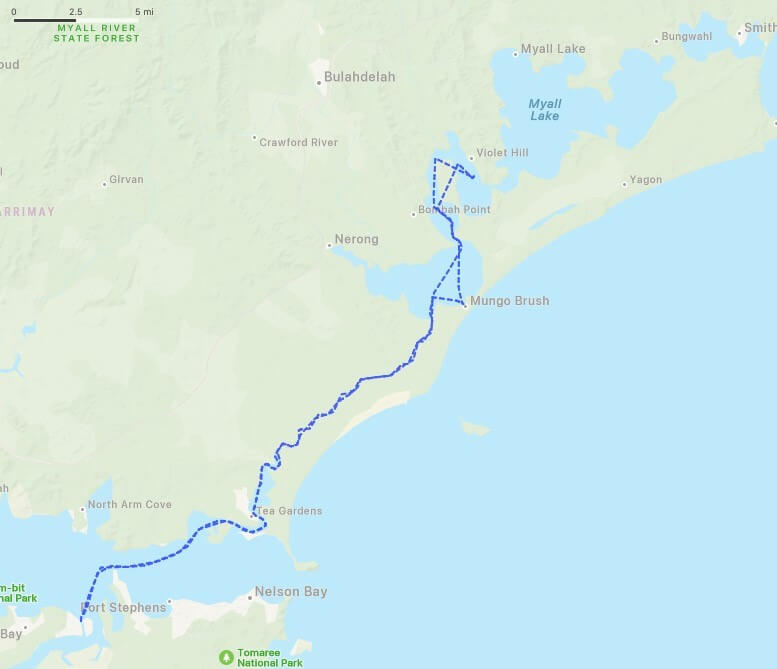
Image: Tracking of LT 30s approximate 110 km roundtrip
Marine Rescue Lemon Tree Passage Unit Commander David Aselford said radio operators at Marine Rescue Port Stephens took the initial call for assistance.
“Marine Rescue Port Stephens was contacted by the crew on board the disabled vessel at 12.15pm yesterday (Monday 7 May) after their six- to seven-metre half-cabin suffered mechanical failure, leaving them stranded near Violet Hill campground.
“Because of the location of the stricken vessel, volunteers from Marine Rescue Lemon Tree Passage were tasked on board rescue vessel Lemon Tree 30.
“We pride ourselves on rapid deployment at Marine Rescue Lemon Tree Passage and aim to be on the water within 14 minutes – which we were,” Unit Commander Aselford said.
The volunteer crew on board LT 30 reached the disabled vessel at 3.15pm, following a challenging trip up the Myall River.
“It is a very tricky waterway – long, winding, narrow and very shallow in parts – with our crew restricted to just five knots,” Unit Commander Aselford said.
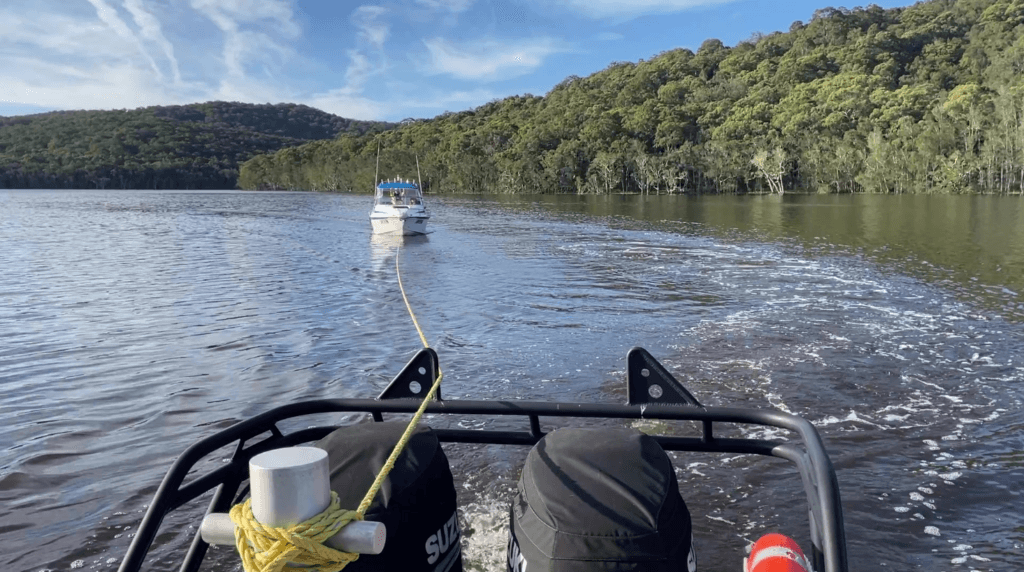
“The two people on board the disabled vessel were relieved when the rescue vessel arrived. A towline was secured and the boaters and their vessel were towed to Mungo Brush Boat Ramp on the eastern side of Bombah Broadwater.
“The boaters were safely returned to shore at 4.30pm before our crew began the slow trip home to Lemon Tree Passage, arriving back at base at 7.10pm following approximately a 110 km round trip.
“Volunteers at Marine Rescue Lemon Tree Passage train for missions like this and regularly practise on the Myall River because the environment on that waterway is very different to open waters,” he said.
Unit Commander Aselford said the rescued boaters indicated they would make a donation to the unit who provided the assistance for free.
“Our crew used $700 worth of fuel during the mission, so their donation will be greatly appreciated.
“While Marine Rescue NSW receives valuable funding from the NSW Government, units also rely on the generous support of communities, partners and grant programmes to keep our volunteers rescue-ready.
“This May, we’re asking people to answer the call and support Marine Rescue NSW in our mission of saving lives on the water.
‘MAYDAY’ is a call for help — we need people to answer our call. Every dollar donated helps our volunteers save lives on the water.
“Our goal of $45,000 represents $1 for every boater Marine Rescue NSW volunteers across the state have saved in the last five years. Donations of $2 or more are tax-deductible and greatly appreciated,” said Unit Commander Aselford.
A volunteer crew from Marine Rescue Newcastle navigated darkness and a fast-flowing run-out tide overnight to rescue a stranded sailor four nautical miles (7.4 km) south of Nobbys Head.
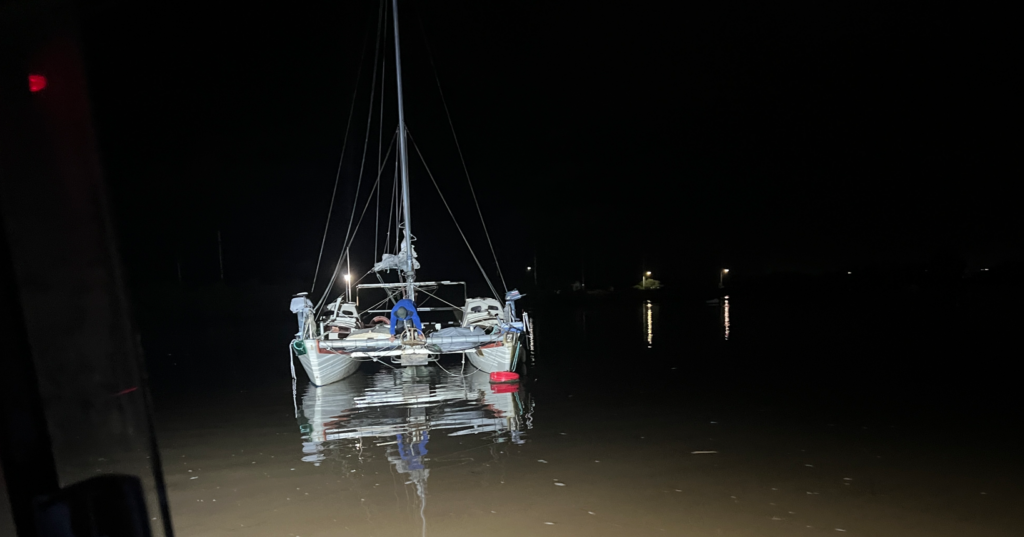
Marine Rescue Newcastle Unit Commander Lyn Van Homrigh said the skipper of a Logged On 11-metre sailing catamaran called radio operators at the Marine Rescue Sydney State Communications Centre at 10 pm last night (Tuesday 29 April) to ask for help after his vessel suffered engine failure.
“A volunteer crew was assembled and rescue vessel Newcastle 30 was deployed.
“The crew reached the disabled vessel at 11:15 pm and checked the welfare of the sailor, who was fine. A towline was then secured to his vessel.
“Because of the weight and width of the vessel, it was a slow trip back into the harbour.
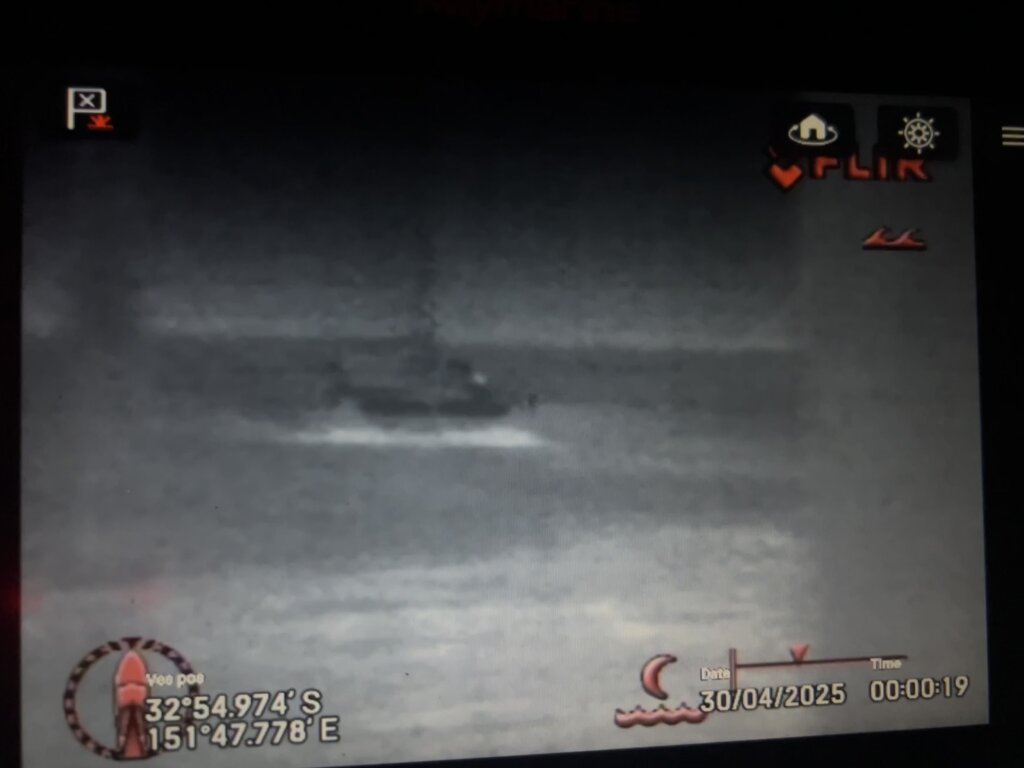
“We used FLIR (forward-looking infrared camera) technology on board Newcastle 30 to assist with safe passage.
“The strong run-out tide on the Hunter River restricted our travelling speed, and Newcastle 30 was required to perform a number of challenging manoeuvres to safely place the disabled vessel on a mooring near Stockton Bridge. At 1:20 am, the skipper and his vessel were secured,” she said.
Unit Commander Van Homrigh is also advising boaters to avoid going out on the water while a hazardous surf warning is in place for the Hunter Coast.
“Surf and swell conditions are expected to be hazardous today and tomorrow.
“Boaters should delay their plans until conditions improve, and always Log On with Marine Rescue NSW via the free Marine Rescue NSW app or VHF channel 16,” she said.
Volunteers from Marine Rescue Newcastle are assisting a multi-agency search for a missing female swimmer off Newcastle Beach.
Marine Rescue NSW Inspector Courtney Greenslade said a volunteer crew was assembled and rescue vessel Newcastle 30 deployed before sunrise today (Sunday 13 April).
“Newcastle 30 was on the water at 5:25 am, with volunteer radio operators managing communications from the Marine Rescue Newcastle base at Stockton.
“Newcastle 30 is conducting a parallel line search with a NSW Water Police vessel.
“Marine Rescue Newcastle volunteers will continue to assist NSW Police Marine Area Command until instructed otherwise.
“Conditions are favourable offshore this morning, with seas under a metre and a 10-knot east to north-easterly wind,” Inspector Greenslade said.
Marine Rescue Tuggerah Lakes will host a search and rescue exercise involving three Central Coast-based Marine Rescue NSW units this Saturday, 29 March.
Marine Rescue NSW Hunter Central Coast Zone Training Manager, Jane Shirriff, said 34 volunteers from the Tuggerah Lakes, Central Coast, and Norah Head units will take part in the vital training exercise.
“We practise our search and rescue skills in a controlled environment so that when the real call comes, our volunteers are best prepared to respond,” Shirriff said.
Twenty volunteers on board five Marine Rescue NSW boats and two rescue watercraft (jet skis) will take part in the on-water search, while 14 volunteer radio operators will manage radio communications for the search scenario from the Marine Rescue Tuggerah Lakes Toukley base.
Shirriff said a scenario will be delivered to participants on Saturday afternoon, focusing on different areas of the lake.
“We will have two search locations on Tuggerah Lake, with four manikins in the water that our crews will need to locate and retrieve in a timely manner using various search techniques,” she said.
One search area will be on the southern side of Toukley Bridge, with crews conducting a parallel line search, while a contour search will be held on waters around Pelican Island.
“Members of the public will notice increased Marine Rescue NSW activity on Tuggerah Lake this Saturday; please don’t be alarmed, we are training. Should an emergency happen, our volunteers will rapidly respond,” Shirriff said.
Marine Rescue NSW volunteers will be on Tuggerah Lake from 9 am this Saturday, with the search and rescue exercise taking place between 1 pm and 4 pm.
A volunteer crew from Marine Rescue Lake Macquarie was activated late last night (Sunday, 23 March) to assist two boaters stranded 13 nautical miles (24km) off Swansea Heads.
Radio operators at Marine Rescue Sydney received a Pan Pan call from the skipper of an 11-metre power catamaran after both engines failed at around 10pm.
A Pan Pan call is made to indicate an urgent situation that is serious but not immediately life-threatening.
Marine Rescue Lake Macquarie Unit Commander Jim Wright was part of the three-person crew deployed for the mission on board Lake Macquarie 30.
“A volunteer crew was quickly assembled and headed for the location of the disabled vessel, while radio operators at Marine Rescue Lake Macquarie managed communications after they were transferred from Marine Rescue Sydney,” Wright said.
“Lake Macquarie 30 reached the disabled vessel at midnight and immediately checked on the welfare of the two crew members on board, who were both fine.
“A towline was secured to the disabled vessel before the long and slow trip back to Swansea.
“We safely crossed the bar and returned the two boaters and their vessel to a mooring on the eastern side of Swansea Bridge just before 2:30am today (Monday, 24 March).
“Thankfully, conditions offshore were reasonable, and our night training served us well.
“It was a seamless response, with excellent communication between the rescue boat, the disabled vessel, and our radio operators, who did a wonderful job,” Unit Commander Wright said.
Volunteers from Marine Rescue Port Stephens have been tasked by NSW Police Marine Area Command to assist in a multi-agency search approximately 30 nautical miles (55 kilometres) east of Newcastle.
Marine Rescue NSW Inspector Steve Raymond saidrescue vessel Port Stephens 31 was deployed around 2pm today, Sunday 23 August.
“The Marine Rescue NSW crew on board Port Stephens 31 are assisting NSW Water Police with a parallel line search after a person reportedly went overboard, during a fishing competition.
“The search is expected to continue tomorrow with Marine Rescue NSW vessels Terrigal 30 and Newcastle 30 ready to assist,” Inspector Raymond said.
Volunteers from Marine Rescue Newcastle have safely returned two people to shore after their 13.5 metre yacht lost steering 18 nautical miles (33km) off Newcastle.
Marine Rescue NSW Inspector Steve Raymond said volunteer radio operators at Marine Rescue Sydney State Communications Centre answered a call for assistance just before 7pm last night, Thursday 20 February.
“The skipper of the distressed vessel advised Marine Rescue Sydney that they had lost steering and needed assistance to return to Newcastle Harbour.
“At the request of NSW Police Marine Area Command, Marine Rescue Newcastle assembled a crew of volunteer members and deployed rescue vessel Newcastle 30 around 8pm.
“Conditions were challenging throughout the entire mission with the Newcastle 30 crew battling one and a half to two metre swells” he said.
Newcastle 30 reached the distressed vessel just after 10pm and secured a towline before making the trip back to Newcastle Harbour.
“The return trip was a slow three hour operation because of the conditions, with Newcastle 30 travelling at three to four knots.
“Newcastle 30 safely manoeuvred the distressed vessel and its crew to a mooring.
“Our radio operators at Marine Rescue Sydney State Communications Centre also did an exceptional job managing communications for the rescue mission,” Inspector Raymond said.
Volunteers from Marine Rescue Newcastle were deployed on board rescue vessel Newcastle 30 in challenging conditions last night to assist a sailing vessel with three people on board, which had become disabled off Stockton Beach.
Marine Rescue Newcastle Deputy Unit Commander Rick Nevile said the 12-metre sailing catamaran became disabled off Newcastle while transiting from Sydney to Port Stephens.
“The skipper of the logged on vessel called for assistance just after 9:30 pm.
“The foresail on the vessel had blown out and could not be furled, and one engine had failed.
“The crew on board the sailing catamaran were also battling issues with their anchors,” Deputy Unit Commander Nevile said.
Newcastle 30 reached the disabled vessel, which was almost four kilometres north-northeast of the harbour entrance and approximately 500 metres off Stockton Beach, just before 9:50 pm.
Deputy Unit Commander Nevile said the Newcastle 30 crew secured a line to the disabled vessel to stop it drifting closer to the beach and to assist in the recovery of its anchors before towing the vessel back to Newcastle Harbour.
“Conditions were challenging. There was heavy rain at times and a very strong south southwesterly wind that made it difficult to manoeuvre around the disabled vessel.
“The swell was also between two and three metres.
“All persons on board the disabled vessel were wearing lifejackets, and the fact the skipper was logged on with Marine Rescue NSW reduced our response time.
“We encourage all boaters to log on with Marine Rescue NSW either via the free Marine Rescue app or VHF channel 16.
“Logging on ensures our dedicated volunteers keep watch for a vessel’s safe return and saves vital time in the event of an emergency.
“The disabled sailing catamaran and its three crew were safely placed on a mooring in Newcastle Harbour just after 11:30 pm,” Mr Nevile said.
Volunteers from Marine Rescue Lemon Tree Passage assisted five people on the Karuah River after their 5 to 6 metre vessel grounded in shallow waters.
Marine Rescue NSW Inspector Steve Raymond said the request for assistance came in around 11.20am yesterday, Saturday 25 January.
“A volunteer crew on board Lemon Tree 30 was deployed under the direction of NSW Police Marine Area Command to assist.
“The crew searched the shallow river for the grounded vessel, which was located just after 11.45am.
“The five people on board had safely made it to a nearby beach.
“After inspecting the vessel in consultation with Water Police, it was unable to be uprighted safely.
“The five people were transferred by Marine Rescue NSW crew to a safe location at Karuah,” Inspector Raymond said.
NSW Maritime were advised of the location of the grounded vessel.
Marine Rescue NSW is a volunteer based not-for-profit professional organisation dedicated to keeping boaters safe on the water and supporting local communities.
Nine people have been returned safely to shore by volunteers from Marine Rescue Lake Macquarie after the commercial vessel they were on started taking on water 5.5 kms off Swansea Heads this morning.
Marine Rescue NSW Inspector Steve Raymond said radio operators at Marine Rescue Lake Macquarie received a call from the skipper of the disabled vessel just before 9am today (Sunday 12 Jan, 2025).
“The commercial vessel was taking on water and at risk of sinking. Multiple assets from Marine Rescue Lake Macquarie were tasked for the response with rescue vessel Lake Macquarie 30 and both rescue watercraft (jet skis) arriving on scene within 20 minutes.
“Nine people were taken on board Lake Macquarie 30 with the support of both rescue watercraft,” he said.
“Lake Macquarie 30 was met by rescue vessel Lake Macquarie 31 at the bar where four people were transferred on board the second rescue boat,” Inspector Raymond said.
“Both Marine Rescue Lake Macquarie vessels then transported the nine people safely back to the Swansea RSL wharf, no injuries were reported.
“Lake Macquarie 30 then returned to the stricken vessel and assisted the skipper.
“The six-metre commercial vessel was secured and towed to Blacksmiths boat ramp.
“This morning’s response was a rapid team effort by our dedicated volunteers at Marine Rescue Lake Macquarie.
“To have the nine people safely on board the rescue vessel and returned to shore in less than 45 minutes shows how highly skilled they are,” Inspector Raymond said.
Under the direction of Marine Area Command, volunteers from Marine Rescue Terrigal aboard the vessel Terrigal 30 have been stood down for the day from the multi-agency search for a missing 15-year-old last seen in the water at North Avoca Beach yesterday afternoon.
Marine Rescue NSW Inspector Courtney Greenslade said conditions “were good to fair, as the easterly winds have picked up slightly above forecast since just before lunch.”
“The crew on Terrigal 30 began the search at 9:00 am after spending several hours searching yesterday afternoon and were stood down for the day at 2:45pm.
“They conducted a parallel line search from North Avoca to The Skillion at Terrigal.
“The commitment displayed by our volunteers both on the water and in radio operations yesterday and today has been exceptional, with our volunteers giving up their Christmas Eve and Christmas Day to continue the search.
“Our crews have returned to base and are awaiting further instructions from Marine Area Command,” Inspector Greenslade said.
Marine Rescue Terrigal volunteers have resumed the search this morning for a missing 15-year-old off last seen in the water at North Avoca Beach yesterday afternoon. Volunteers on board Terrigal 30 resumed the search at 9am.
Marine Rescue NSW Inspector Steve Raymond said “the water swell has eased since yesterday, and search conditions have improved”.
“The team will be conducting parallel searching from North Avoca to The Skillion at Terrigal under the direction of NSW Police Marine Area Command”.
Volunteers from Marine Rescue Terrigal will be back on water Christmas morning assisting the multi-agency search for a missing teenage boy off North Avoca Beach.
Marine Rescue NSW Inspector Steve Raymond said a volunteer crew on board Terrigal 30 spent two-and-a-half hours searching waters off North Avoca Beach this afternoon before being stood down for the day at 7pm.
“Marine Rescue Terrigal volunteers will continue the search at 9am tomorrow morning (25 December) on board Terrigal 30.
“Terrigal 30 will conduct search patterns in an area to be determined by NSW Police Marine Area Command,” Inspector Raymond said.
A volunteer crew from Marine Rescue Terrigal has been tasked to assist NSW Police Marine Area Command with a search for a missing 15-year-old boy off North Avoca Beach this afternoon (Tuesday 24 December).
Marine Rescue NSW Inspector Steve Raymond said a volunteer crew was assembled and rescue vessel Terrigal 30 was deployed just after 4:30pm.
“Terrigal 30 rendezvoused with a NSW Water Police vessel off The Skillion and is now conducting search patterns under the direction of NSW Police Marine Area Command.
“Conditions offshore are choppy with 2.5 metre to 3 metre swell,” Inspector Raymond said.